The turnout for the No Kings 3.0 gathering in Reykjavík yesterday was small, but there were roughtly 20 of us gathered in solidarity with those protesting in the States. The weather was rough all week, including orange alerts for most of the country, and the wind chill yesterday was below zero. We lasted for an hour and a half outside before heading to a nearby restaurant, but not before a grotesque Jabba-the-Hutt-style snow pile effigy of Trump was constructed. These are dark times, so finding ways to spend time with likeminded people and push back against authoritarianism matters, no matter how small. I loved seeing the rallies in large cities across the United States; I wish I could have been there.
No Kings 3.0 in Reykjavík. Photo credit: Devin Kuchcinski.
I got confirmation this week that I was accepted for a creative residency at Williamshús in the Faroe Islands. Located in Tórshavn, Williamshús is the former home and studio of William Heinesen, one of the most famous Faroese writers. The basement and first floor are a museum, and the second floor apartment hosts residencies. I’ll be there for twelve days in July. I intend to focus on writing and photography, likely publishing to Looking North throughout the stay but also gathering material for longer-term projects. I’ve wanted to go back since first visiting in 2018, but with more of a purpose than simply another tourist visit. I think staying at Williamshús will fit that goal perfectly.
This week was the start of the Reykjavík Open at Harpa, an annual international chess competition. I didn’t realize that chess was a big deal in Iceland, but apparently it really took off after the country hosted the World Chess Championship in 1972, pitting Bobby Fischer against Boris Spassky. That match, and the way it put Iceland “on the map,” was the reason the government gave Bobby Fischer Icelandic citizenship when the United States was seeking his extradition for violation of economic sanctions against Yugoslavia.
In 2005, Fischer moved to Iceland and lived there for the rest of his life. I knew that he settled near Selfoss, but I only recently learned that he also spent a lot of time hanging out at Bókin, a used bookstore in Reykjavík that is one block from my apartment.
Reykjavík Open 2026, after hours.First Day Cover for the Icelandic postage stamp commemorating the 1972 International Tournament in Chess in Reykjavík, released in 1976, and also promoting that year’s tournament.
Distance can be measured in many ways — the most obvious being time or space — and I’ve always been fascinated by how those two ideas are intertwined: a light-year away, a ten-minute walk, the future is in front of us. After all, a GPS satellite is essentially a floating atomic clock; its coordinates, without the exact time they were transmitted, would be meaningless. Anyway, Iceland hasn’t observed Daylight Saving Time since 1968, so while I still live in Reykjavík, I’m now an hour further away.
Mt. Esja covered in snow
Last week I said that winter had arrived, but this week it really showed off. On Tuesday, the first snowfall in Reykjavík set records for October, reaching a depth never before recorded this early in the season. It was a chance to break out the winter gear that took up so much space in my suitcase last July, and I had a blast wandering around in the blizzard. Near the harbor, it was crazy to see boats still out on the water, their lights disappearing just a few meters into the fog and snowfall — I wouldn’t want to be onboard. I had to keep my camera in a dry bag in-between shots; the snowflakes were so wet and fluffy, perfect for making snowmen. The day after, it was cool to see that the Reykjavík Grapevine published some of my photos that I sent in when they called for reader submissions.
A snow covered lane near the Danish embassy.In the days afterwards you really had to watch out for slow falling off roofs.Harpa in the snow.
I’ve been wondering about winter in Iceland, and how things might compare to the US, given that I’ve lived in snowy places like Chicago, Minneapolis, and Michigan. Setting aside the early arrival, the amount of snow was similar to storms you’d expect multiple times a year in any of those places. So far, I would rate snow removal as better in the US, at least in terms of pedestrian spaces. There doesn’t seem to be an expectation that homeowners and businesses clear the sidewalks. I’ve seen few people shoveling, and little evidence of salting. There are some heated sidewalks, using geothermal heating, but it’s not widespread.
The key factor that makes Icelandic winters tougher is wind — gale force winds combined with icy roads make for risky driving. But one thing Iceland does really well is track realtime info on road conditions throughout the country, with color coded road segments, wind speed, and traffic cams. There are also regional color codings (yellow, orange, red) that provide a more general warning. I’d seen yellow warnings before, but Wednesday was my first orange warning, which basically means “don’t travel” and led to most businesses closing early.
The day after the snowstorm was a perfectly clear night and the northern lights came out strong. I felt lucky to capture this image of the aurora dancing around the Imagine Peace Tower.
Noted & Done
Settled on topics for the two Arctic papers I need to write over the next month (more on that later).
Last week I mentioned that the lighting of the Imagine Peace Tower was happening on October 9th, and I had tickets to take the ferry over to Viðey Island to attend in person. But the weather in Iceland had other plans. Starting the day before, the kind of winds that can only originate at sea hit Reykjavík, with gusts up to 56 MPH at the time I checked my weather app. The windchill dropped the temperature by 27°F and while it was calmer the following day the organizers still decided to cancel the lighting ceremony out of caution. I’m told it’s just typical autumn weather; it was mid-50s and calm soon after. But it gives me a better sense of why plans in Iceland need to be flexible when strong gale winds can whip up quickly.
Screenshot from the Windy.com app on October 8, 2025
I did get a chance to attend a related event, the Imagine Forum, an annual conference put on by the Höfði Peace Center, which had a theme this year of “Protecting Rights – Defending Peace.” The day-long event brought some powerful voices to Iceland, from areas of the world most grappling with peace and human rights.
The Iranian actress and activist Nazanin Boniadi talked about the severe restrictions that women in Iran face, and her work to establish international recognition and law around the term gender apartheid. Her stories of repression were paired with examples of women pushing back, risking and often facing horrific consequences. She emphasized the intergenerational aspect of hope in this fight, of how women in Iran can learn from their grandmothers, in photos and stories, about a time when they had more freedom than they do today.
Varsen Aghabekian, the Minister for Foreign Affairs and expatriates of the State of Palestine, spoke as the ceasefire in Gaza was agreed to and the world holds its breadth in hope that this could be the moment the genocide stops. It felt important to hear directly from her about the need for accountability, and the importance of a two-state solution, but I was left with the same intractable feelings about how that will be possible in the face of extremist attitudes.
The final speaker I want to highlight is the one that has stuck with me most, Vladimir Kara-Murza — a Russian opposition politician, historian and former political prisoner. In 2023 he was sentenced to a Siberian prison colony for his political views, and freed the following year as part of the largest prisoner exchange between the US and Russia since the end of the Cold War. He told stories of Putin’s rise to power that frighteningly mirror what Trump is doing in the US today, in particular his consolidation and control of the media. He also emphasized that we should not believe there is universal support for the Ukrainian invasion amongst Russian citizens. He told the story of a man jailed for five years for simply responded to an opinion poll and saying he was against the war. When the consequences for resistance are so extreme, there is no reliable data about public opinion.
These three speakers were representing terrible environments for human rights and peace, and yet it was striking how much each of them embodied feelings of hope. After his talk, Vladimir Kara-Murza was on a panel with Rósa Magnúsdóttir, Professor of History at the University of Iceland, and they both used their historical expertise to frame today against the arc of history. Asked about how he remains hopeful Kara-Murza told a story from the previous week, where he had flown into Frankfurt and then drove to Strasbourg for an event. He reflected on how that region of Alsace was soaked in the blood of history, after so many wars fought between Germany and France over the territory. Yet today you would never suspect it, with no border crossing, a single currency — it’s hard to even tell which country you’re in.
It’s hard to zoom out like this, when each day the grip of authoritarianism only seems tighten, and it’s easier to imagine tomorrow based on the trajectory of today than the cycles of the distant past. But as these speakers showed, the worse it gets the more important it is to remember that it doesn’t have to be this way. The grandmothers in Iran remember a different life, the collapse of oppressive regimes accelerates quickly when it occurs, and despite the tyrant’s attempts to hide it their actions are not popular. What I took away is the need for hope, and persistence, and perhaps hardest of all patience.
If you’re interested, a recording of the entire Imagine Peace Forum 2025 is available on Vimeo.
Next week is an major event I’ve been looking forward to since before moving to Iceland, and integral to my studies of the Arctic while I’m here. The Arctic Circle is the largest gathering of politicians, academics, business leaders and others focused on a wide range of Arctic-related topics. They’re expecting 3000+ attendees from over 70 countries, with lots of ministerial level speakers.
I’m not only attending, but will be a delegation volunteer, which means I’ll be on-call to support whichever delegation I get assigned, helping with whatever needs come up throughout the 3-day event. I don’t yet know which delegation that will be; I find out tomorrow. This means I’ll have full backstage access to the conference, and this week I attended an orientation that involved touring the Harpa conference center. I’m a little worried about providing concierge services to a foreign delegation when I’ve only just learned the ropes myself, but it should be an interesting learning experience.
From the top floor of Harpa conference center.
Last night I saw Hania Rani perform at Fríkirkjan, the Lutheran church built in 1903 in downtown Reykjavík. Almost a year ago I saw her for the first time at the Cedar Cultural Center in Minneapolis and was blown away. Similar to that concert, she was surrounded by numerous keyboards, including a grand piano, which she treated almost as a single instrument, swapping between them or playing them at the same time. The experience was fantastic, and the music a bit different than before as she was performing under her pseudonym Chilling Bambino, which is more synthesizer focused.
The keyboard setup for the Hania Rani show at Fríkirkjan.Photo via Instagram user @mona_blank.
Hania is Polish, and this performance was sponsored by the Polish Embassy. Immigrants from Poland make up the largest group of foreign-born inhabitants in Iceland, totaling 32% of the immigrant population in 2024.
Finished reading The Rebellious Ally: Iceland, the United States, and the Politics of Empire 1945-2006 by Valur Ingimundarson. This must be the most comprehensive English-language text on Iceland’s deeply intertwined history with the United States. I found it fascinating and if you’re at all interested in Iceland, American history, WWII, or the Cold War then I highly recommend it. It is not easy to find in print, but luckily the full book is available as a PDF download.
Related to the reflections above, on history as an avenue for hope, I don’t know why it took me so long to discover Heather Cox Richardson. She’s a professor of American history at Boston College and runs a widely read daily newsletter on politics. I’ve been finding her YouTube channel insightful.
After my trip to the Westfjords last week, this one has been pretty heads-down. The weather was mostly dreary, with enough rain that 50 meters of the ring road in eastern Iceland was simply washed away. The timing of various coursework sort of stacked up on me, which means I have a few presentations and a few essays all due this coming week. But honestly, that’s not such a bad thing to overlap with inclement weather.
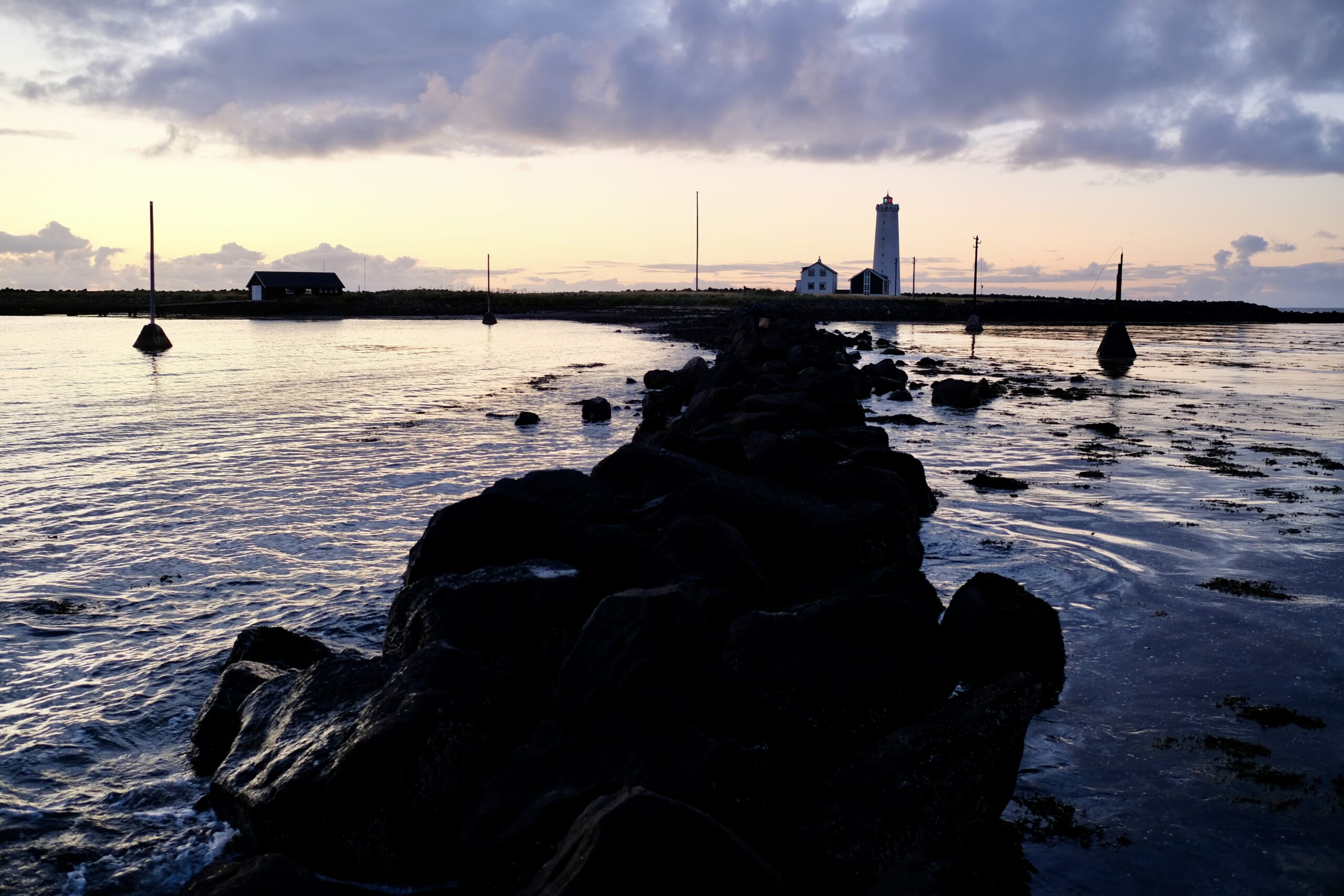
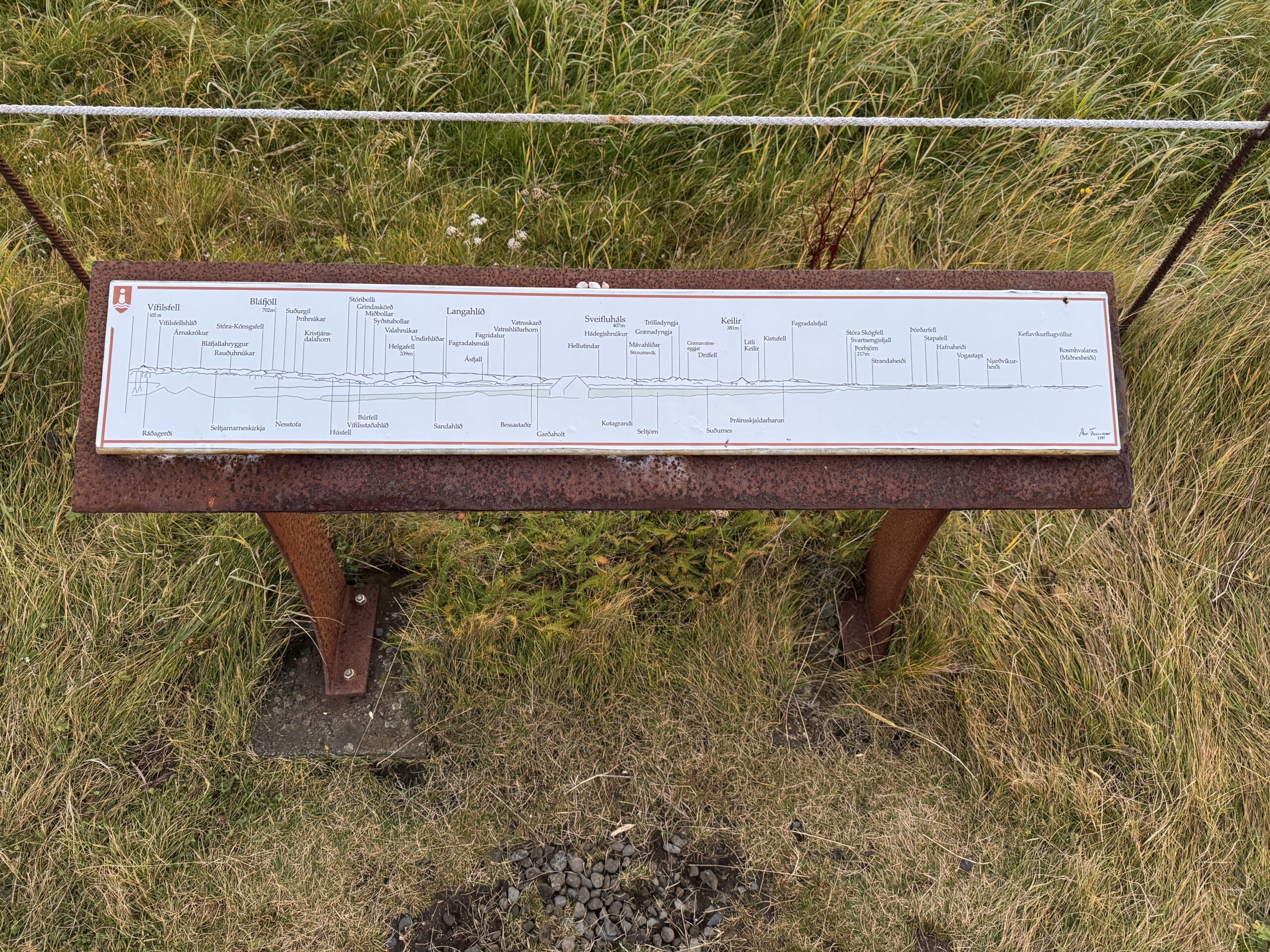
Island of Grótta
A fascinating thing about Iceland is that everything has a name. The photo above is from the Island of Grótta, which I visited yesterday off the tip of the Seltjarnarnes peninsula, but you’ll find similar horizon-labelling signs throughout the country. They indicate the names of not just prominent peaks or landmarks, but every valley, ridge, indentation, rock outcropping, and farm. Armed with this vocabulary, you could refer to the environment with incredible precision, and combined with all the nuanced words for wind (this website lists 14) then just imagine the richness in which you could describe air moving through the landscape.
And yet, names for Icelandic people are more limited. This week the Icelandic Personal Names Committee approved seven new names, and while I confess that I don’t know quite how it works there is apparently a defined list of names that parents must choose from. Combined with the patronymic naming structure used in Iceland, this leads to a lot of similar sounding names. The approval of a name is based partly on its ability to work with Icelandic grammar and alphabet rules, although there are additional criteria depending on if it’s a given name, middle name, or surname.
All of the official rulings of the Personal Names Committee are public, and the most interesting (of course) are the denials. This one for Óskir was rejected because it’s already the plural of the established proper name Ósk, while this one for the middle name Hó got stopped by the ambiguous judgement that it could “cause trouble for the name bearer.” The middle name Boom was ruled against as it is “not derived from an Icelandic root word,” which is required for middle names, but not given names. I feel like I could easily lose an afternoon digging through this database (and shoutout to Google Translate for making that possible).
Tomorrow, September 29, is my birthday. I’m just happy to put this one behind me, but time marches forward and somehow I’m 47 years old.
Went to a Hekla show at Mengi, which was my second time seeing her perform this month as she was also part of the Extreme Chill Festival. What can I say, I’m a fan of the theremin.