Iceland: Week 45

This week brought the kind of summer sun that garners local headlines about an “epic heatwave,” which in Reykjavík means 68° Fahrenheit. On Friday, I took a long walk around the city and the mood was ebullient, with Nauthólsvík beach full of sunbathers midday and most people opting to soak in the sea instead of the geothermal pool. I decided to take advantage of the favorable forecast and rented a car for the weekend, aiming to explore some relatively nearby places that I haven’t been to yet. I didn’t want to book a hotel, so I split the travel into two long day trips: heading north to Vesturland on Saturday and then driving around the “golden circle” area on Sunday.

Nauthólsvík beach

My first stop was a hike to see Glymur, the second tallest waterfall in Iceland, which is tucked into a narrow canyon at the head of Hvalfjörður. The trail is over a thousand feet of elevation gain, and rises steeply enough to be glad for rope supports along the way. You also have to cross the river twice, once by balancing on a log that is only placed seasonally, and then back again when you reach the top. The second crossing is a very cold wade through a wide stretch of river, still calm before it cascades over the edge. I’m hoping to do this hike again in a couple of weeks with a friend who will be visiting, so it was good to learn about the river crossings ahead of time. I’ll bring a towel and some extra socks next time.

A partial view of Glymur. There is no viewpoint on the trail from which you can see it in its entirety.

I also went to see the Grábrók Crater, which I’ve driven by numerous times but never with the right circumstances to stop. It provides an incredible view of the surrounding lava fields from the top.

From the top of Grábrók Crater

In comparison to the road trip with my parents two weeks ago, when the lupine were just beginning to sprout, they are now everywhere! These purple vertical flowers line the sides of nearly every country road, and fill whole valleys along the sea. I know that they’re an invasive species in Iceland, but they’re beautiful.

The bridge across Hvítá River in Borgarfjörður.
Lupine just south of the bridge that connects to Borgarnes.

On Sunday, I headed east, looking to avoid the ring road in favor of smaller routes through areas I hadn’t seen before. Route 435 to 360 took me along the southern edge of Þingvallavatn, the massive lake that is home to Þingvellir National Park. This is a major energy-generating area, and I enjoyed seeing the steam plumes of the Nesjavellir power plant and visiting the exhibition at the Ljósafossstöð hydroelectric plant. One of the displays in the exhibition was a simple chart of energy usage in Iceland versus the rest of the world. Iceland uses 100% renewable energy, with hydropower accounting for nearly 3/4 of the pie and geothermal making up the difference, save a tiny sliver of wind power.

One thing I learned was the difference between hydropower plants like Ljósafossstöð, which can operate fairly consistently based on freshwater lakes and rivers, versus plants that capture power from the highland rivers, which have variable output depending on seasonal snow and glacial melt. Apparently that’s one area where wind power has been useful, letting them maintain higher reservoir heights in those locations if there is wind power to fill in the gaps.

Steam from the Nesjavellir power plant
Turbines at the Ljósafossstöð hydroelectric plant

Afterwards I visited Kerið Crater, which is interesting but unfortunately on the bus tour route and thus busier than I’d like. I also find their fee structure annoying. Most everywhere in Iceland there is a parking fee, since most of the sites are privately owned and the landowners need to recoup their cost of providing infrastructure for visitors. Kerið likes to advertise itself as having free parking, but that’s only because they charge an entrance fee. For me, a solo traveler, those are one and the same. But for a family that means the 700 kroner that is typical for parking is now multiplied by the number of people, which starts to feel excessive.

Perhaps the best thing about visiting Kerið was spotting something even more eye catching in the distance, a bright red spot on a mountain to the northeast. Leaving the crater, I drove towards that splash of color, winding up a dirt road towards what I could see upon closer inspection was a rock quarry. The exposed layers of earth were fantastically colorful: bright reds, yellows, and tans. A sole worker in the pit was filling a truck with volcanic debris, his yellow loader dwarfed by the size of the quarry walls.

While driving up to the quarry I saw some people in high-visibility vests in the hills, and assumed they were just walking their dogs. But when I reached the top there were numerous search and rescue vehicles, and I realized that this was a training exercise for rescue dogs. I talked with one of the trainers for a while, who told me about the different classifications the dogs can achieve, such as avalanche or water rescue certifications. They were taking advantage of the unusually warm weather to see how the dogs performed in those conditions. It was basically hide-and-seek, where the trainers would run off to lay in a valley on the other side of the hill and the dogs were given items of theirs to smell and go track them down.

The rest of the day was meandering. I stopped by the Friðheimar greenhouses to try their famous tomato soup. I’ll never pass up a chance to see Gullfoss, and was surprised to see that the top viewing area now extends further than I remember. I also went to Brúarfoss, which I had never seen before, and was blown away by the uncanny bright blue water. On the way back I stopped to see Þórufoss, which is one of those waterfalls that reminds you how incredible Iceland is because if it were anywhere else, it would be the main attraction, but here it’s a lesser-known spot with barely a sign to indicate its presence (although it was a Game of Thrones filming location).

Friðheimar greenhouses
Always amazed that Gullfoss can have this amount of water flowing over it in perpetuity.
Brúarfoss
Þórufoss

Iceland: Weeks 21 + 22

This is my first Iceland post that needed to span multiple weeks. In the previous fortnight I wrapped up everything for my first semester at the University of Iceland and my brother visited for five days. It was really fun to have him here, his first time in Iceland, and despite the very minimal amount of sunlight (~3.5 hours per day) we had a great time exploring the Reykjanes Peninsula and south coast.

When I met Isaiah at the airport, at a little past 7am, we still had at least 3 hours before the sun would start peeking above the horizon, so we caught up in a cafe before heading out. Iceland immediately showed off its weather diversity as we drove from drizzly Keflavík through the snow-covered lava fields of Reykjanes. The first stop was more of a conceptual one, but established the mind-blowing geological newness that is Iceland: a bridge between continents that connects the Eurasian and North American tectonic plates. The country is basically split in two by these plates, the source of volcanic activity that led to the creation of Iceland 20 million years ago and all the continued eruptions today.

Bridge between the Eurasian and North American tectonic plates

Near there is Gunnuhver, a geothermal area, where the mixture of snow, steam, and sunrise seemed like a fitting introduction to Iceland.

Gunnuhver geothermal area
Isaiah at the Gunnuhver geothermal area
A graveyard along the Reykjanes southern coast. During Christmas cemeteries in Iceland are lit up like this.

This time of year the sun never really stops rising or setting, but by the time we arrived in Grindavík it was light enough to see the impact of the nine dramatic eruptions that caused the town’s 3,700 residents to flee in 2023. The town is surrounded by newly constructed lava barriers, and in the city center there’s a fissure that cracked and shifted the street by a meter or more. New roads have been cut through the lava, and there are signs of rebuilding, but most residents haven’t yet moved back.

A new road cut through the lava field, seen from the top of a lava barrier.
Isaiah on a lava field from the 2023 eruptions.

Our next stop was Hveragerði, where we hiked into the mountains to the Reykjadalur thermal river. The sun had already started to set when we started around 2:30pm, so we packed headlamps for the walk back. That was smart, but it would have been even smarter for us to not leave our crampons in the car. The ~5 mile round-trip hike was icier than we anticipated, but beautiful, and soaking in the hot springs surrounded by snow covered mountains felt amazing.

The view over the geothermal valley
Reykjadalur hike
Reykjadalur hot springs area. This is the main site for soaking, with a boardwalk and minimal changing zones.

We stayed in Reykjavík that first night, and the next morning made headway down the south coast before sunrise so we could maximize the minimal daylight. The weather was cooperative throughout the trip, with very little rain or snow. The temperature was moderate, mostly just above freezing, but the wind got up to 40 mph. At times, it felt like pushing on a heavy door just to walk forward and twice it literally knocked me to my knees.

The south coast did not disappoint, and it’s truly the biggest payoff for a limited amount of time in Iceland. It’s amazing how many things are just off the ring road, and while these accessible sites are busy with tourists, even in winter, it wasn’t overwhelming. We went to Seljalandsfoss, Skógafoss, Sólheimajökull, and Reynisfjara before running out of daylight in Vík, and continuing the drive to our hotel in Hof.

For this first day, I have photosets on Instagram of horses, Sólheimajökull, and Reynisfjara.

A herd of Icelandic horses congregated along the road and were happy to see us. I love how they are so genetically specific and yet each one has such a distinctive look.
The Eyjafjallajökull icecap, underneath is the volcano that erupted in 2010 and caused 20 countries to close their airspace.
Obligatory waterfall selfie. Unfortunately, this time of year they don’t let you go behind Seljalandsfoss due to icy conditions.
Sólheimajökull glacier, which I went ice climbing on just a month previous. It was fun to come back so soon and see the changes in the icebergs and lagoon.
I brought my other camera lens (50–200mm) along for this trip to Sólheimajökull, which let me capture slightly different views of the glacier than when I was there previously with only my 23mm.
This ice arch is an example of something that I didn’t see last month, and it probably won’t be there a month from now.
Very rough seas and intense wind at Reynisfjara, the black sand beach.
Basalt pillars on the Hálsanefshellir cave.
Black sand beach with Dyrhólaey in the distance.

At sunrise the next morning we went to the Jökulsárlón glacier lagoon and Diamond Beach, where icebergs calve off the glacier and float out to the sea, washing up on the black sand. It’s a stunning place, with bright blue ice that feels surreal amid the immensity of the Vatnajökull ice gap. I have a photoset on Instagram with more images.

An iceberg just off shore that hadn’t been washed onto the beach yet. I saw a photo someone took two days after this that looked like it had broken in two, with a large piece on the sand.
Ice chunk on Diamond Beach in pre-dawn light.
Jökulsárlón glacier lagoon

Perhaps the most unexpected experience was going to the Fjallsárlón glacier lagoon and realizing it was frozen solid. The Jökulsárlón lagoon doesn’t freeze in winter, because it mixes with salt water from the ocean, so after cresting the hill that reveals Fjallsárlón it was almost hard to process what we were seeing: massive icebergs, frozen in place, with people walking amongst them.

It’s pretty amazing that in a short two-day trip we were able to visit three different outlet glaciers. Whether it’s winter or not, my top tip for the south coast of Iceland is to not miss Fjallsárlón, if you are going all the way to Jökulsárlón. It’s only 15 minutes west and an equally wonderful experience. I also have a separate photoset of Fjallsárlón on Instagram.

A frozen glacier lagoon at Fjallsárlón
The Fjallsárlón glacier
A blue-ice arch in and iceberg at the Fjallsárlón glacier lagoon

The final stop on our south coast tour was Fjaðrárgljúfur canyon, where a winding river has cut a scenic path. I somewhat sheepishly realized that I first learned about this place because it’s the splash screen on my banking app, which feels like finding out about national parks from MacOS wallpaper. But it’s a beautiful spot, and definitely worth the hour or so if you have the time (and daylight) to spare.

Fjaðrárgljúfur canyon

I have lots more photos, but this post is already very long. Overall, it was great to have Isaiah visit and nice to see spots on the south coast that I hadn’t yet visited during this time in Iceland. I went as far east as I’ve ever been, but no further. This Spring I’m hoping to break that barrier and make it all the way to the Eastfjords.

Outside of our roadtrip we walked around Reykjavík, which made me realize just how small it is. By day two of exploring the city we had gone to 80% of the areas I frequent, ate well, and avoided spending too much time in my tiny studio apartment. It’s always interesting to wander around a city with Isaiah because as an architect he sees things in the built environment that I don’t. We have similar but different designer afflictions: I spot the bad kerning on signs, he notices when courtyards don’t align. But he also looks up who designed the buildings, so now I realize that every day I walk by three or four buildings by Guðjón Samúelsson.


I’ll be traveling to the U.S. for the holidays, my first time leaving Iceland since I arrived in mid-July. I realized this week that my time here matches my longest living out of the country; I was in India during 2011 for the exact same time period. I’ll be in the States for three weeks, returning just before the next semester starts on January 12th. I’m probably going to take a break from writing here during that time. Happy new year to everyone that’s been reading this blog. I appreciate hearing from you, thank you for following along.

Noted & Done

  • Iceland will not take part in next year’s Eurovision, in protest of Israel’s participation.
  • UNESCO has added Icelandic swimming pool culture to its list of intangible cultural heritage of humanity.
  • Icelandic sculptor Steinunn Thórarinsdóttir did a talk at Scandinavia House in NYC last month and the video is now online.
  • Finished Shetland season 10, which was very much like every other season but that’s fine with me. I watch it as much for the landscapes as I do for the plot.
  • Finished my two research papers and will heartily recommend Zotero for managing sources, notes, and most of all footnotes. I honestly don’t know how I would have managed my footnotes and bibliography formatting without this tool. One of those pieces of software that you immediately can not imagine living without.

Iceland: Week 17

I finally got to walk on a glacier. I’ve seen them from a distance when hiking alongside their imposing presence on the Laugavegur trail, and up close on a boat to the calving front in the Jökulsárlón glacial lagoon. I have memories of a planned glacier walk in Alaska that was scrapped when I was twelve years old, visiting my Aunt Debi with my grandparents, but that was too long ago to even remember the circumstances. This week I finally got on top of (and even inside!) the glacier Sólheimajökull, an outlet of the the larger Mýrdalsjökull ice dome sitting atop the Katla volcano.

Sólheimajökull terminus
Icebergs reflecting in the glacial lagoon

 Sólheimajökull is probably the most accessible glacier in Iceland, which is why I was able to visit it on a day-trip from Reykjavík. It’s a skinny, 12 km long valley, that terminates in a glacial lagoon that wasn’t even there in 2009, but grows 50 meters larger ever year as the glacier retreats due to rapid melting since the turn of the century. There is a timelapse video on Vimeo that captures the change from 2007 to 2018, and the Glacier Change website has numerous slide-over comparison photos, the most dramatic of which compares photographs from 1930 and 2023. My guide thought there may be only a couple more years where it will be possible to access the ice from easy approach we took, as the front pulls away into the valley.

The surface of Sólheimajökull is partly covered by black volcanic ash from the nearby Katla volcano, which hasn’t had a major eruption since 1918. Thin layers of ash can accelerate the melting of of the ice, since the darkened surface lowers reflectivity and increases heat absorption. But if the layer of ash is thick enough it can actually slow melting by acting as an insulating blanket.

Ash covering on the Sólheimajökull glacier

Once you get past the lagoon and actually up glacier the thickness of the ice becomes more obvious. What isn’t apparent when looking at the lagoon is that it’s 60 meters deep, which as our guide pointed out is nearly the height of the Hallgrímskirkja church in Reykjavík. That’s why exploring a glacier requires caution, because that surface is full of crevasses, which are cracks, but also moulins, which are formed by flowing water and can create drop offs all the way to the bottom. A glacier is not solid ice, there is always water melting and flowing within it.

The tour I took was not just walking on the glacier, but ice climbing into the glacier, and the photos above show the moulin that our guide identified for us to climb. The second shot, leaning over the edge, I took while attached to an anchored tether that hooked on to a harness. I would not want to lean over this edge otherwise, as a slip and fall would have been disastrous — I couldn’t see the bottom.

The crampons you wear for ice climbing are a little different than I was used to, mainly the addition of spikes near the toes, as it requires kicking the ice wall hard enough to stick and support your weight as you reach up and secure your next position.

Our guide identified a “blue ice” spot that was strong enough to anchor the rope, which could supposedly support up to 1,000 pounds. You strap the rope to your harness and then essentially just walk backwards over the edge of the moulin, walking down the ice wall with the tension of the rope supporting you. Then, once you’ve gone as deep as you’d like, you turn vertical and stab your feet into the ice to begin climbing out.

Making my way up
Almost to the top

Ice climbing was a lot of fun, and much easier once I got my technique down and stopped trying to pull myself up from the ice axes. Ideally you are stuck to the wall by your toes, and only use the axes to balance and take the next step up. Our guide was a Frenchman named Steve who was very patient with climbing newbies and apparently quite the adventurer himself. He’s planning a solo, 550 km unsupported ski trip across Greenland next year. I have photosets on Instagram of the glacier and a separate one for ice climbing. if you want to see more photos.

I would highly recommend this day-trip through Arctic Adventures for anyone who is interested. The transport option from Reyjavík also includes stops at the Skógafoss and Seljalandsfoss waterfalls, the latter of which is skipped later in the winter due to lack of daylight. But luckily for me, I got the opportunity to walk behind the falls as the sun was setting.

Behind Seljalandsfoss at sunset

The other big event this week was Iceland Airwaves, a 3-day music festival that grows to fill the whole week with numerous off-venue events and takes over the entire downtown area. I had a festival pass, and saw a least a dozen acts over four days. All of the venues are within walking distance, so it’s easy to check out a performance and decide to move on midway through if you’re not feeling it. In general it was a little too heavy on the dance/club side of things, but there was huge diversity with folk, hip-hop, neo-classical, rock, and electronic in the mix. Some of the acts I wanted to see simply went on too late for this middle-aged man, and jam-packed venues are less fun once it gets past drunk o’clock — but overall it was a fun experience.

The festivals is a showcase for Icelandic musicians, but also had lots of the UK, Faroe Islands, US, and EU countries. I knew very few of the names going into it, but enjoyed the sets I saw by Jelena Ciric, lúpina, Ólöf Arnalds, knackered, Antony Szmierek, RAKEL, Hania Derej, Milkywhale, Lea Kampmann.

Noted & Done

  • A recent survey noted that the Icelandic sheep population has dropped by 100,000 in the past ten years, leaving only 350,000 sheep in Iceland. That means that today is the first time there has ever been more people than sheep in Iceland.
  • The USD/ISK exchange rate is still bumpy but is finally creeping back up. It reached its nadir right as I moved here, so any improvement is welcome from my perspective.
  • Finished watching season 3 of The Diplomat, which is no Borgen, but continues to hold up pretty well as a US political drama. Given that it’s been part of my studies I was delighted to see the United Nations Convention on the Law of the Sea show up as a plot element.

Iceland: Week 10

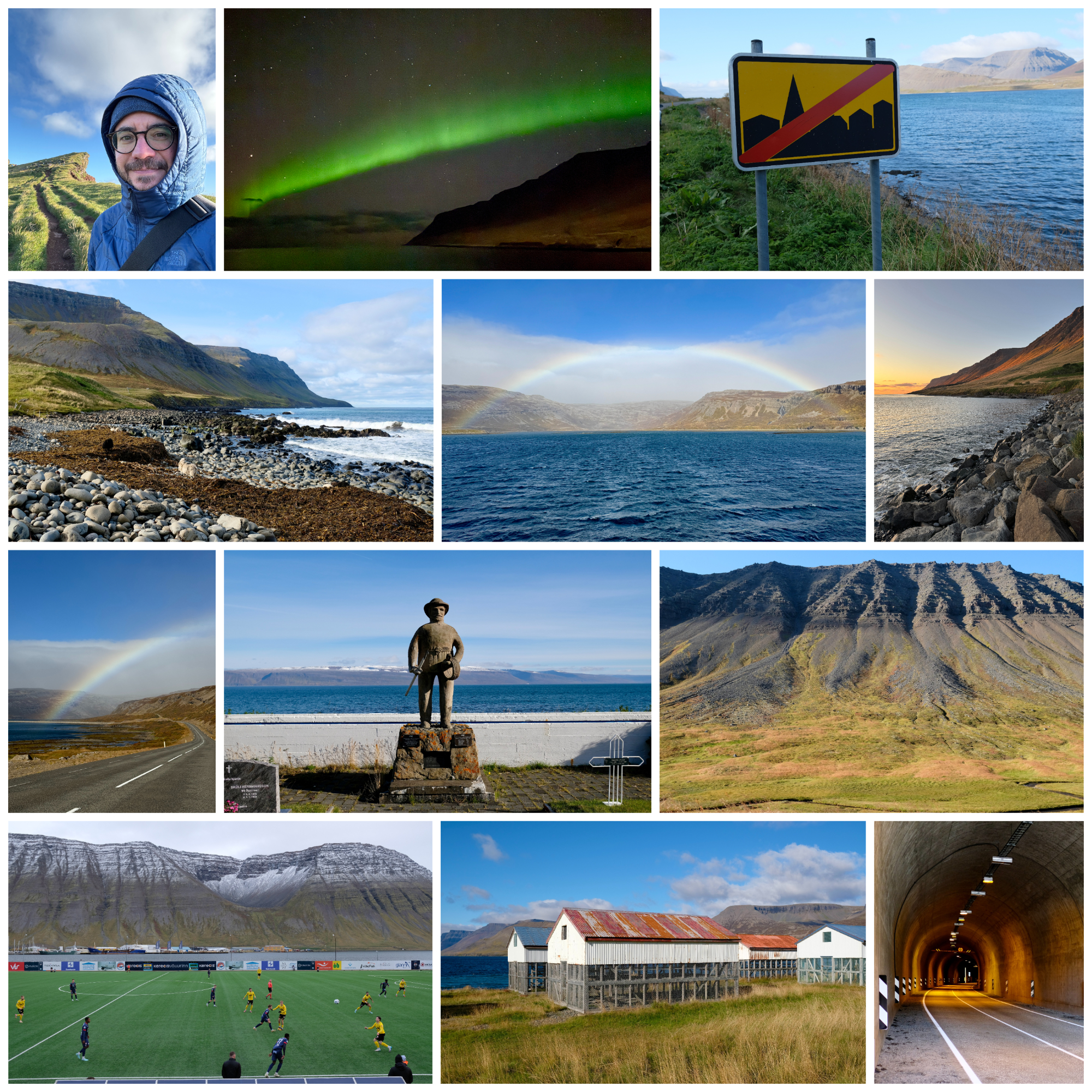
I just got back from my first trip to the Westfjords, a region that has fascinated me for a long time. It’s like Iceland turned up to 11: least populous, most remote, deepest fjords, oldest landscapes. As a multi-day excursion off the ring road it’s sometimes overlooked by tourists, even when they’ve circled the whole country. It felt to me like a bigger version of the Faroe Islands, reminding me of the area around Klaksvík, as well as the southern island of Suðuroy. There’s something calming for me about these landscapes. The sharply steep mountains hold their rocks at an impossible angle of repose, sparing only a tiny strip of flat land along the water to site a village. It’s as if the hills are gently squeezing the fjord, and like a geologic version of the Temple Grandin hug machine, it induces a sense of stillness and quietude.

I had the opportunity to take a long weekend trip because my Thursday classes were cancelled this week, due to my professor traveling. The timing was perfect, as this is about as late into the year as I’d want to go. Winter comes early in the Westfjords, but right now the autumn foliage in the mountains is all rusty reds and yellows, with only occasional pockets of snow and ice at higher elevations.

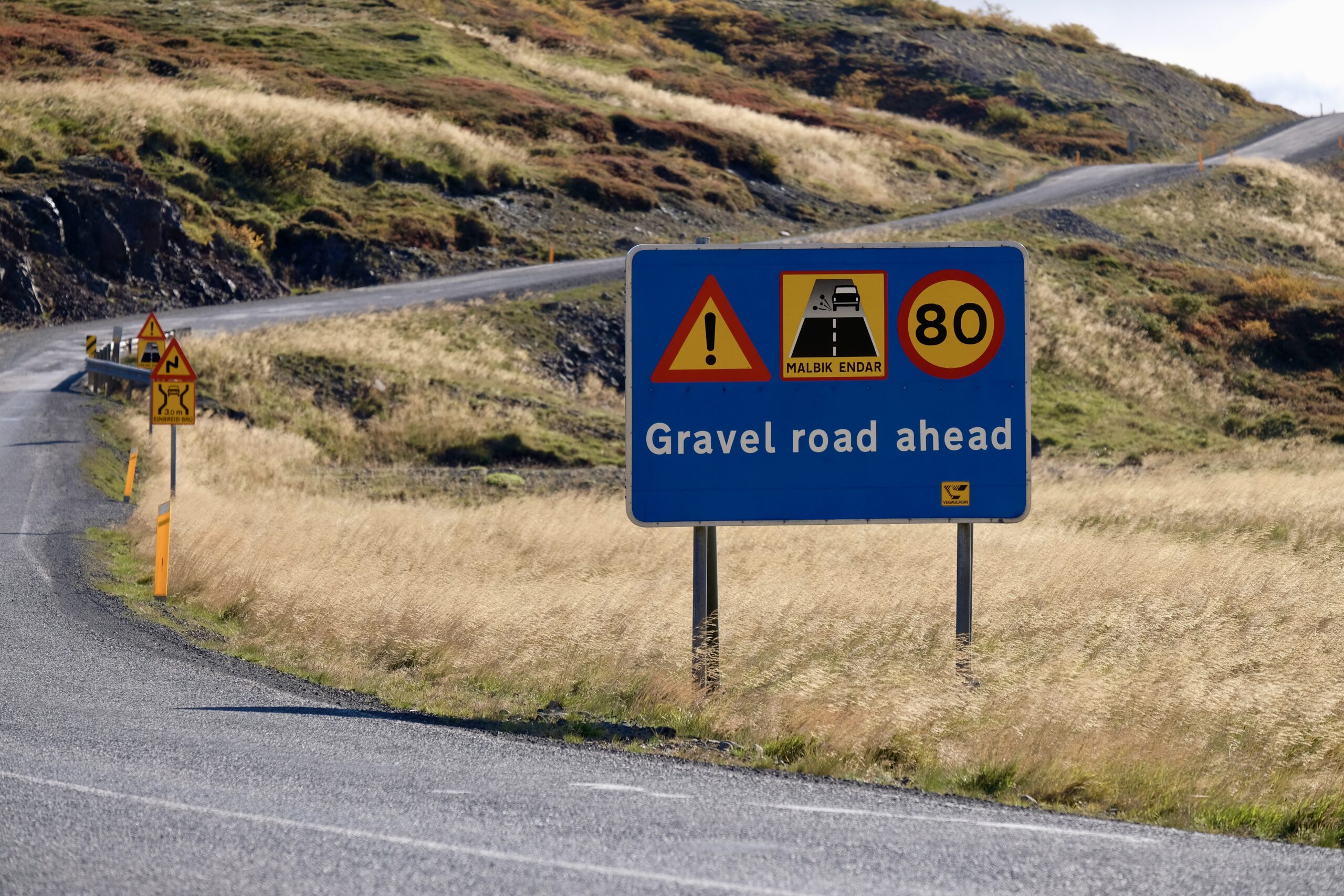
The primary “two digit” roads (e.g. 60, 61) through the region are mostly, but not completely paved. The “three digit” roads (e.g. 612, 624) are paved in proportion to the size of the village they lead to, and the spur roads that snake into valleys to reach a single farm are always gravel. The weather was nearly perfect — sunny and blue skies — although windy and cold of course. I rented a basic 2-wheel drive car, which worked fine, but it would have been tricky in mud or ice. Only once did judge that I should turn around, when I found myself climbing a steep grade over a mountain to an abandoned farm and the path turned to snow. It’s good to know that my tiny inner voice of self-preservation is still alive and well.

But in general, the good weather made it easy for me to just roam around — to the cliffs and water falls on the sightseeing maps, as well as the back streets of tiny villages, the harbor corridors of fish processing plants, and even a local football match. I have photo sets on Instagram for each day (day 1, day 2, day 3), but I’ll highlight some favorite moments below.

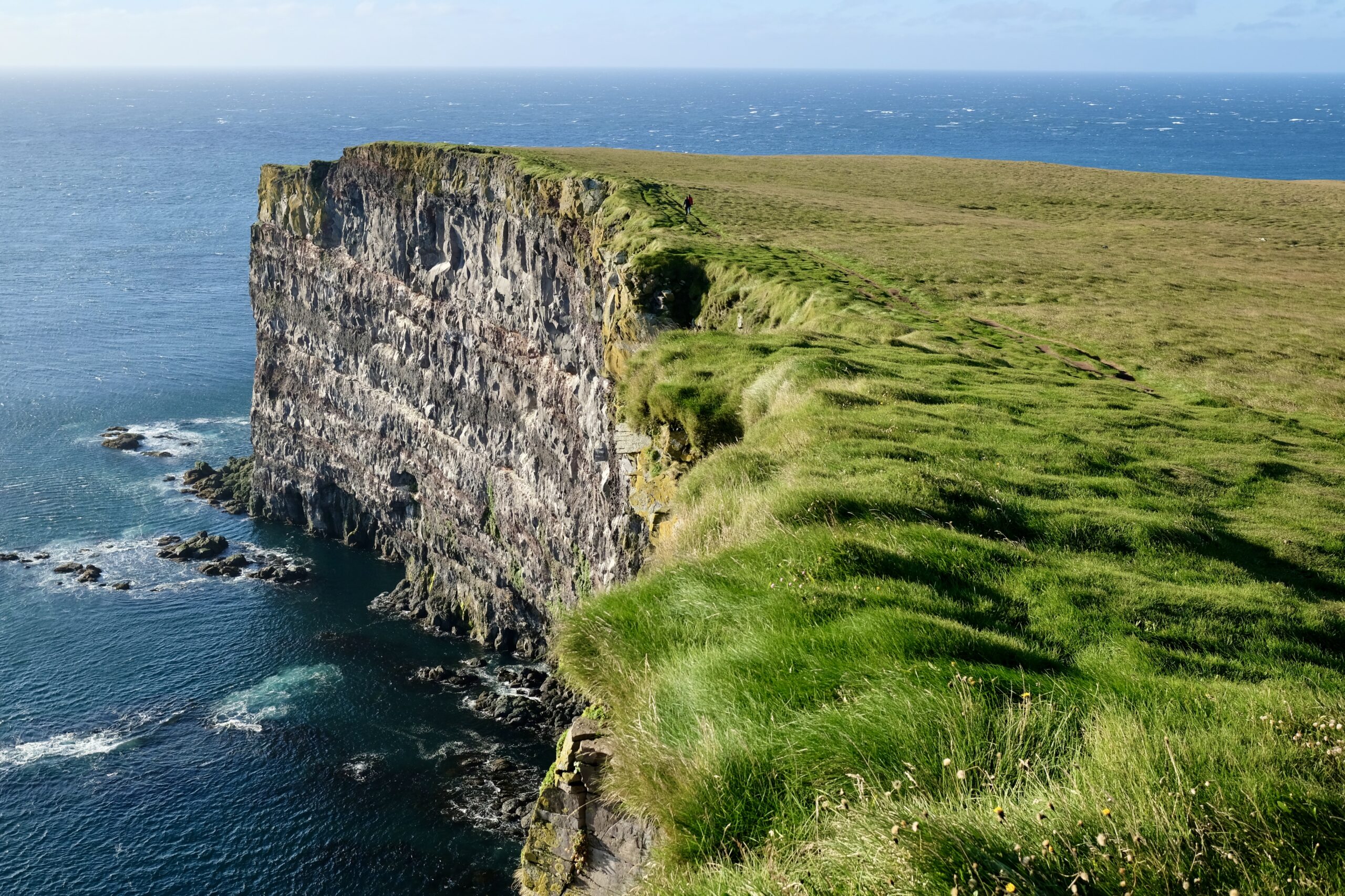
The Látrabjarg sea cliffs are on the southwest tip of the Westfjords. A reason for me to go back is that earlier in the year these cliffs are full of sea birds (including puffins). It’s the westernmost point in Iceland, as well as Europe (although apparently the Azores make that claim too).

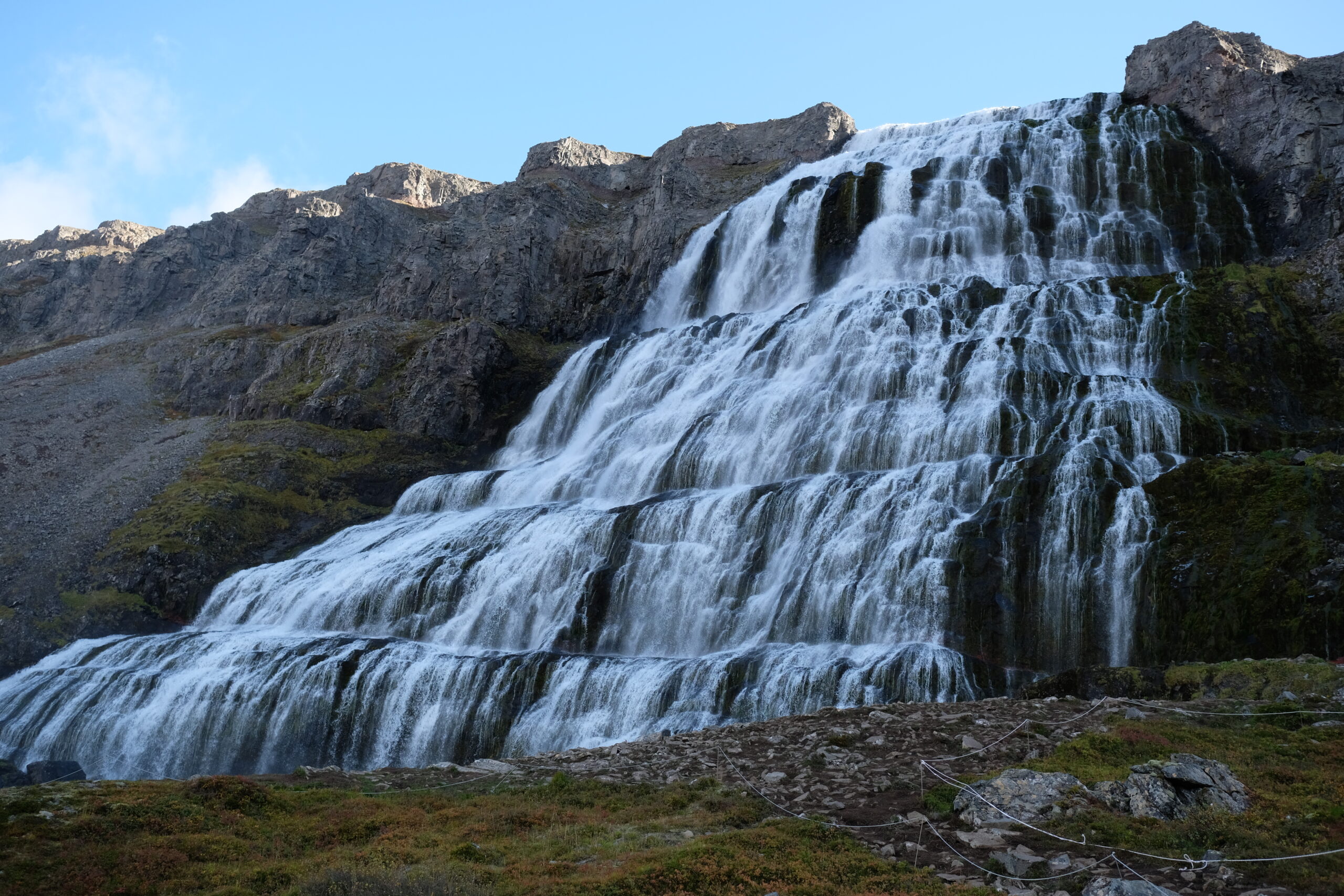
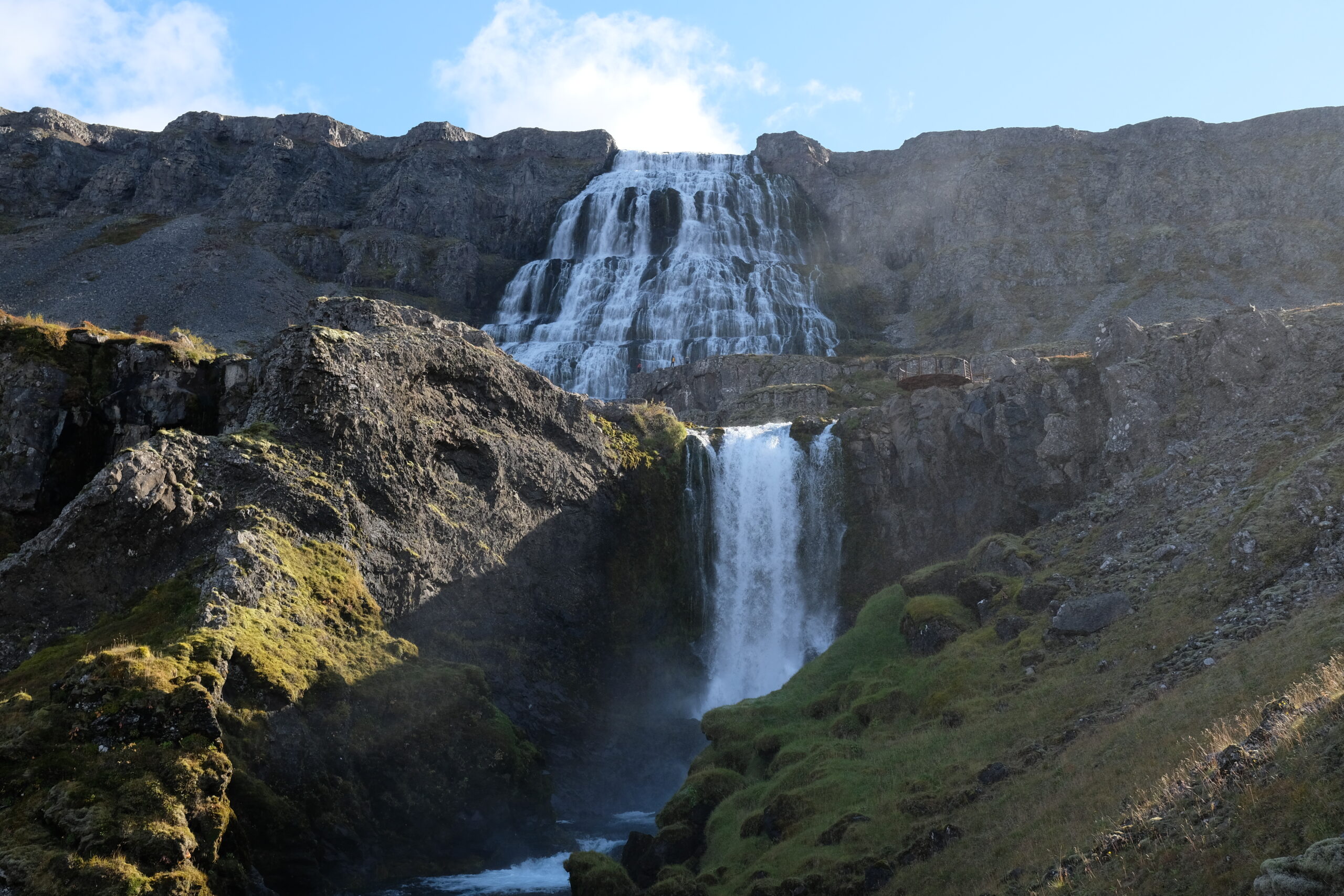
The Dynjandi waterfalls is a massive cascade that feeds numerous other waterfalls below it. I really wonder what this one is like in the winter, as it was already starting to ice up and the dispersed nature of the cascade makes me think it could freeze in interesting ways.

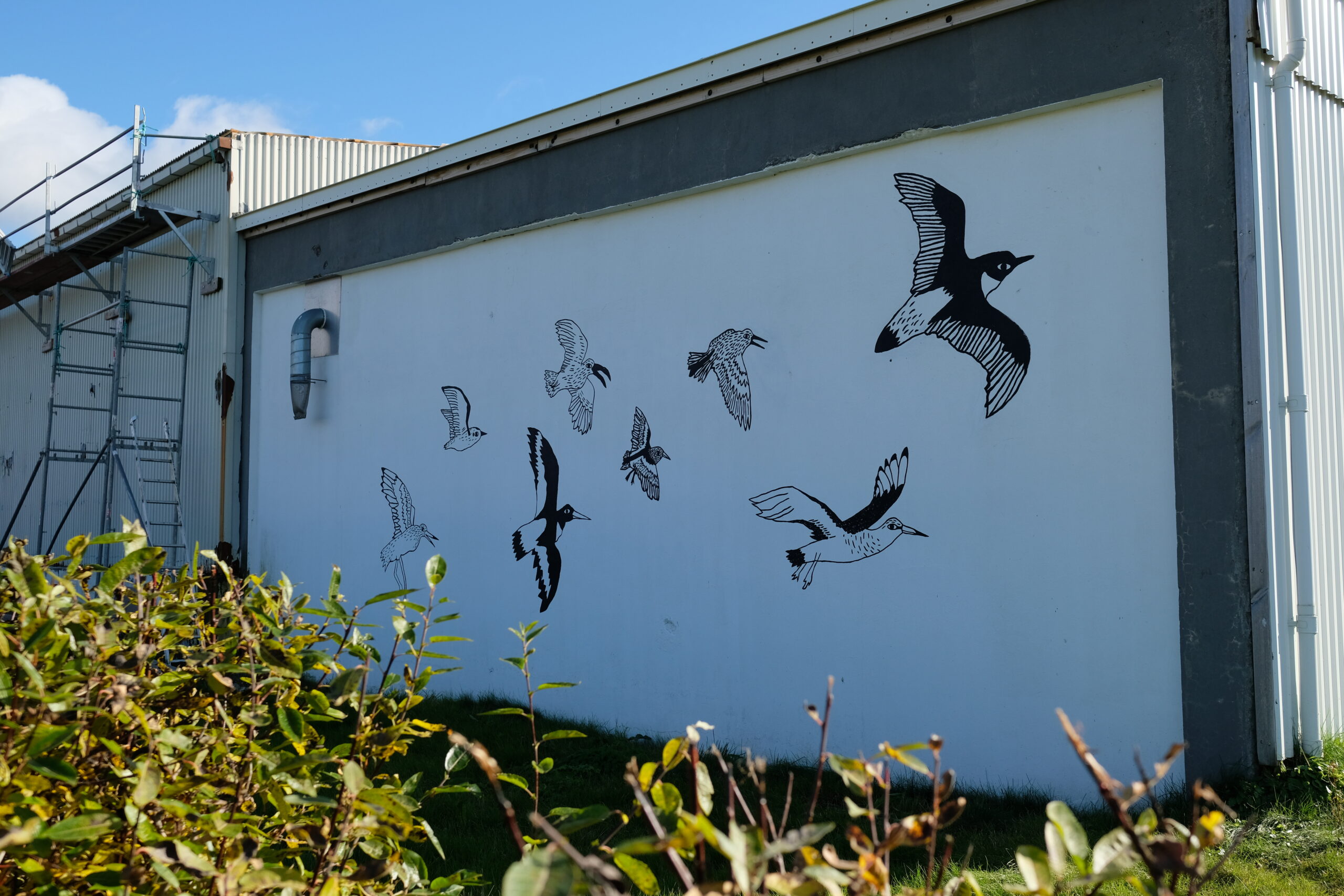
I spotted these birds while driving around the back roads of Þingeyri, and they looked strangely familiar. I realized that it was because they were painted as part of a scene in a movie I recently watched, Summer Light, and Then Comes the Night, which must have been filmed in that village.

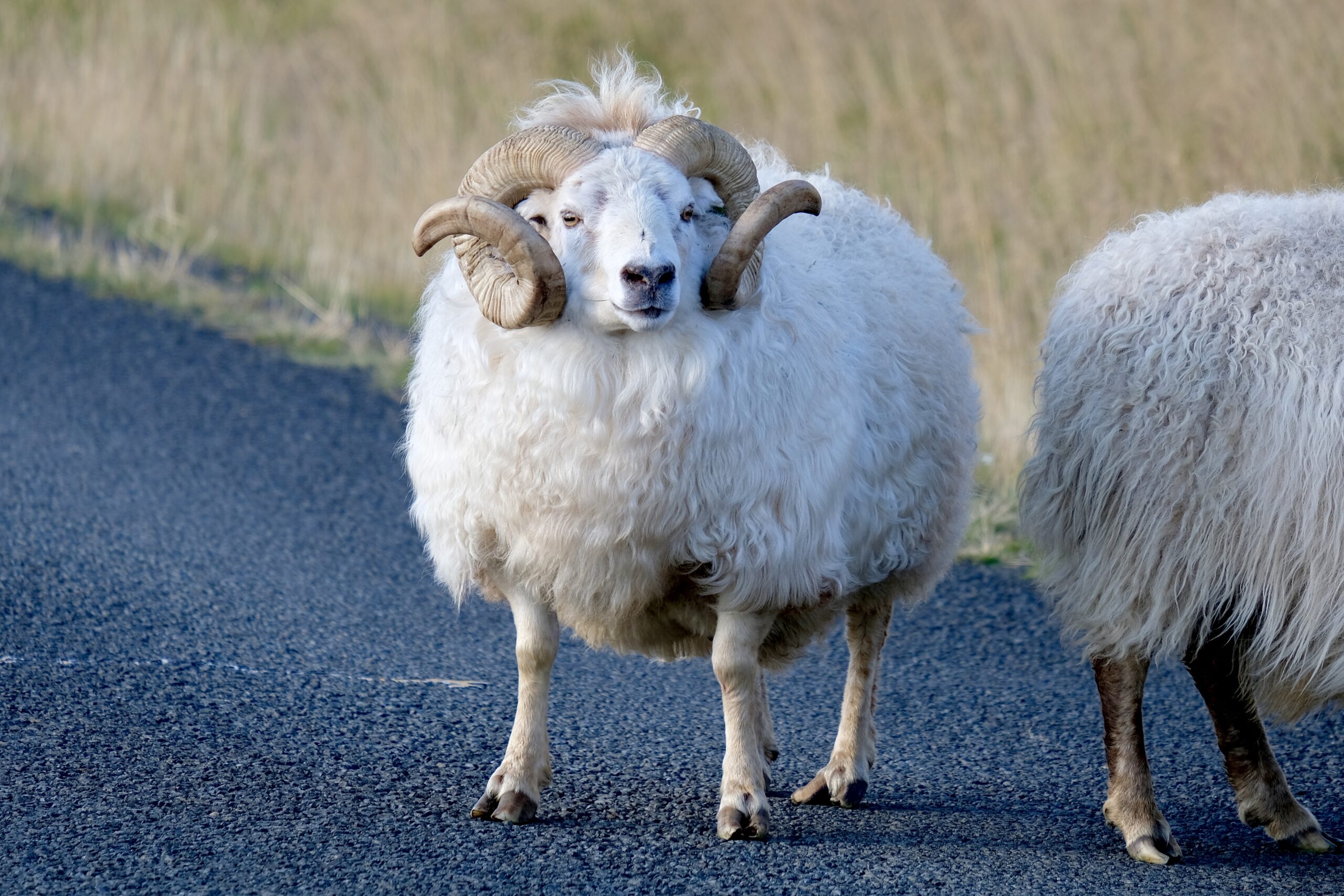
I met a lot of sheep, but these were the finest set of horns.

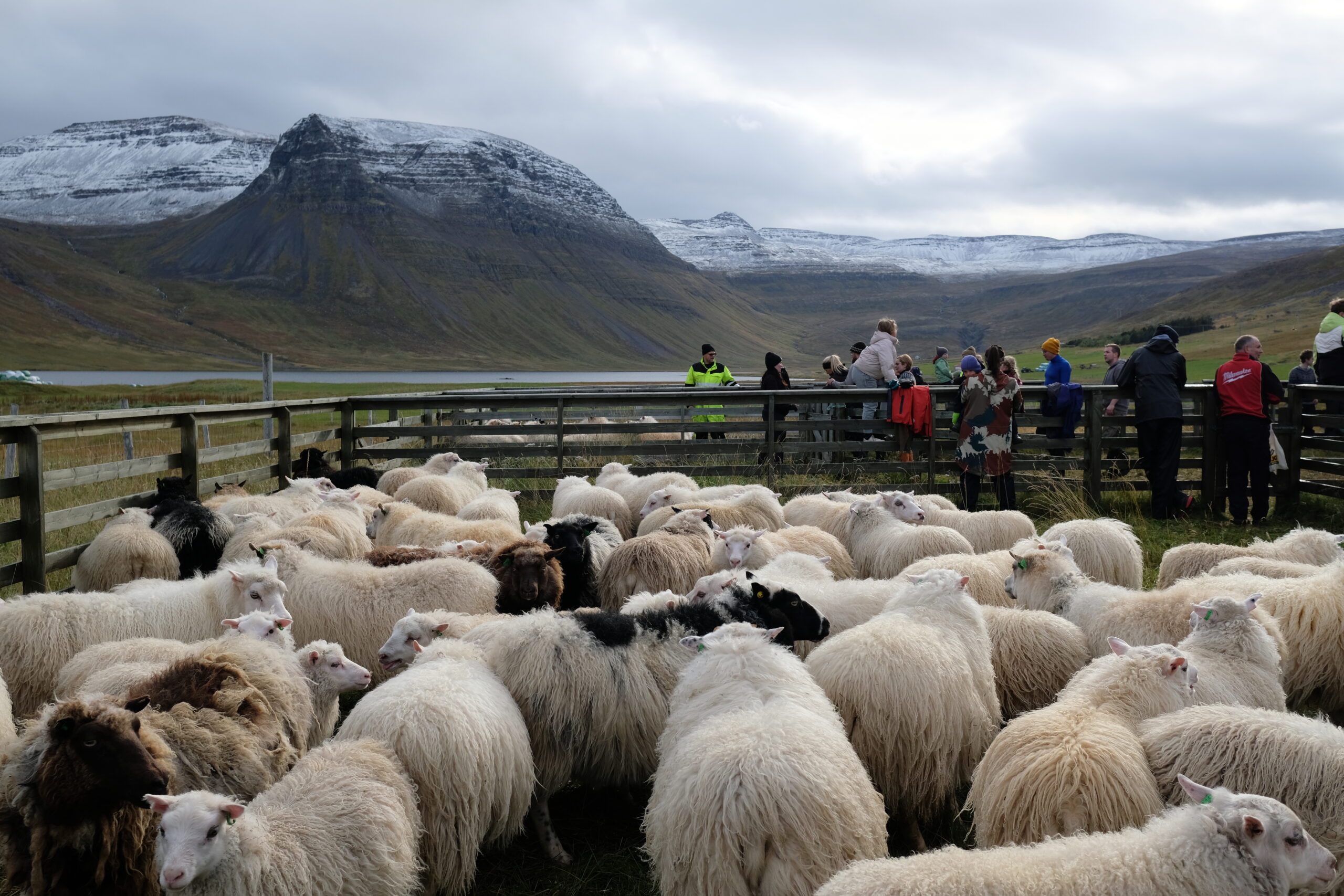
One payoff for rambling down a gravel road was encountering a sheep roundup in progress! I’ve been wondering how to attend one of these, so it was a real treat to stumble into it. I felt like the outsider that I was, so I snuck in quietly and tried not to get in the way. Everyone there knew each other and were having a lovely time. They sorted the sheep they had rounded up that morning from the nearby area and corralled them into different pens. Then they loaded all the ones that belonged to a particular farmer into a truck.

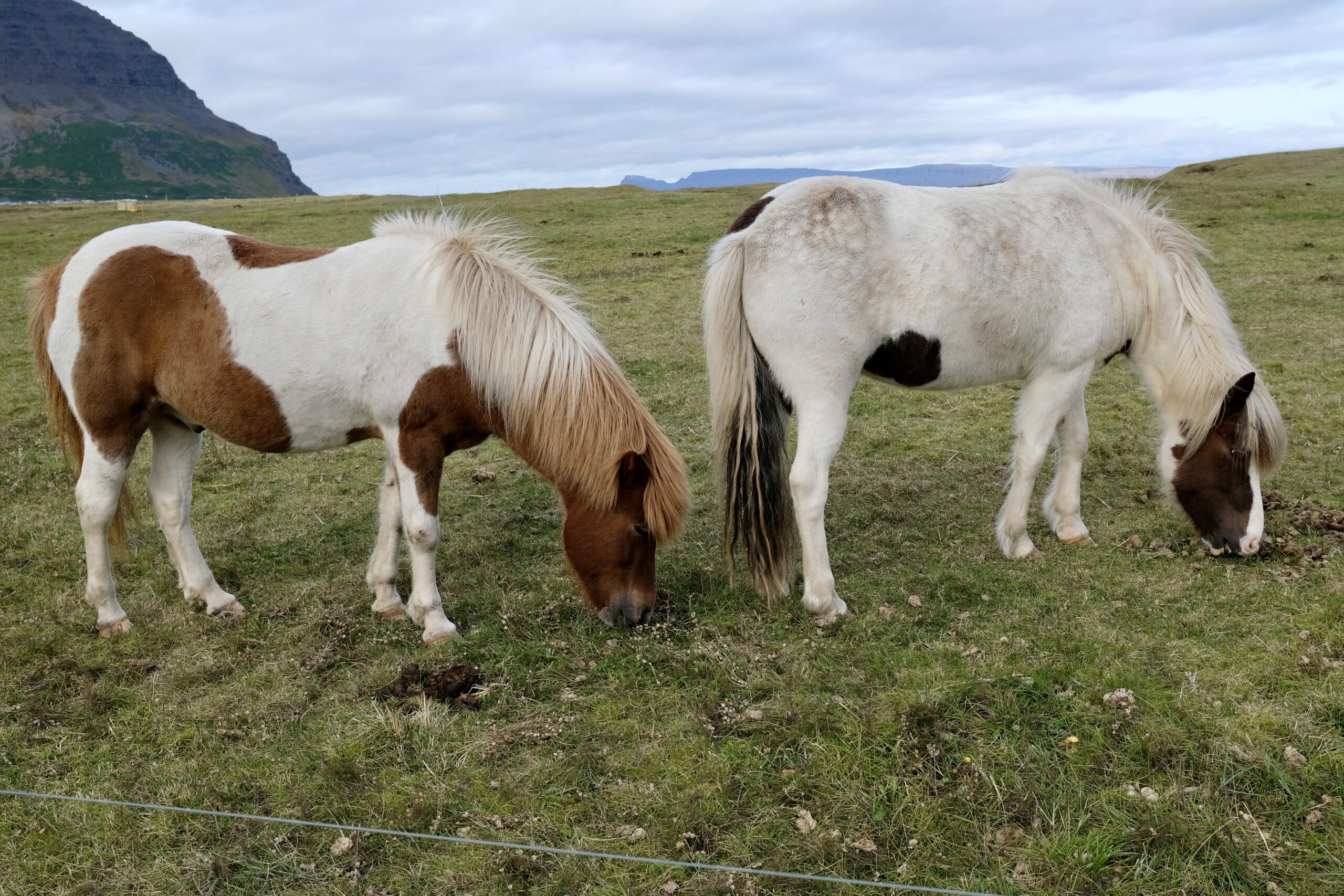
I also met some horses, but there were fewer in the Westfjords than on the southern coast.

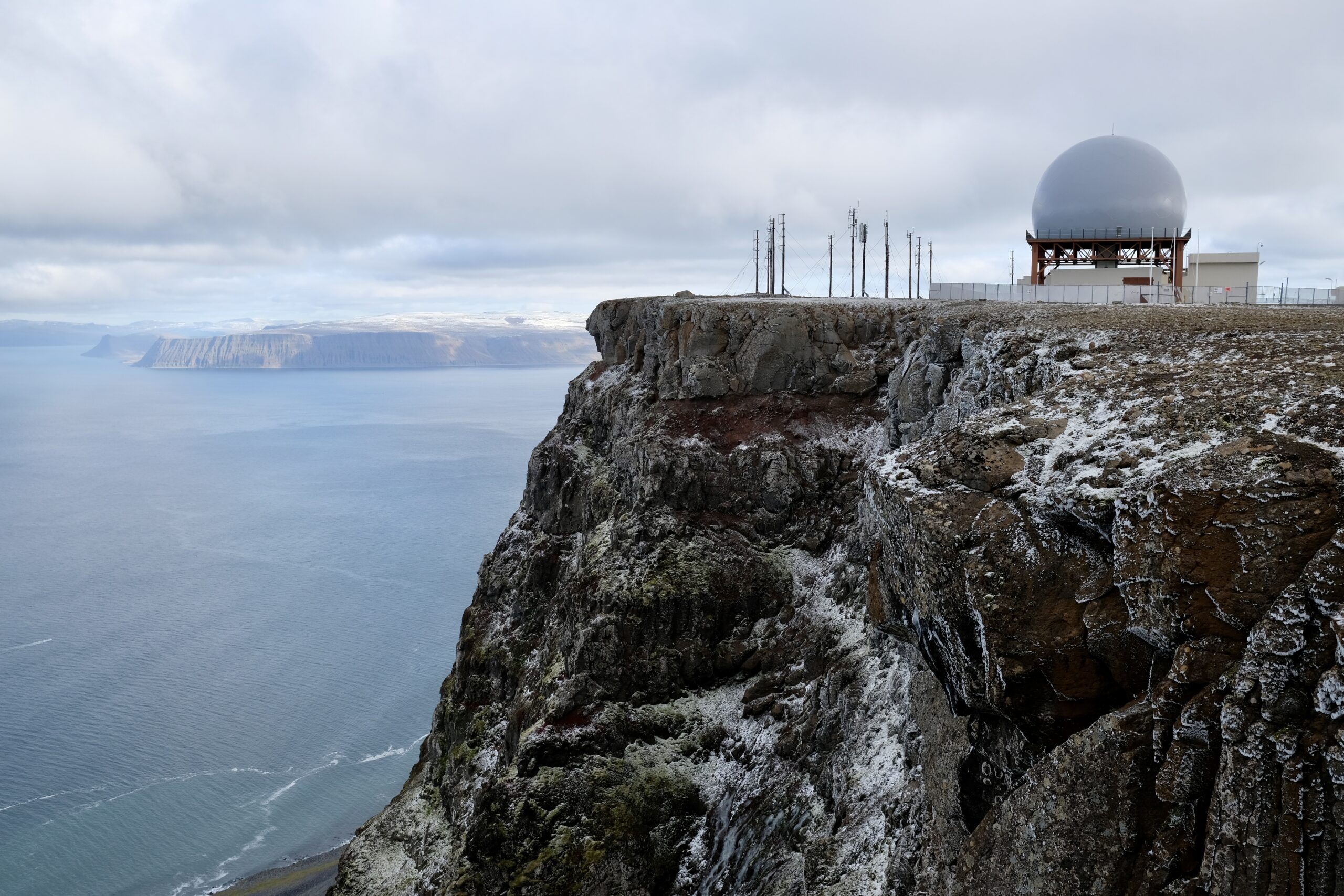
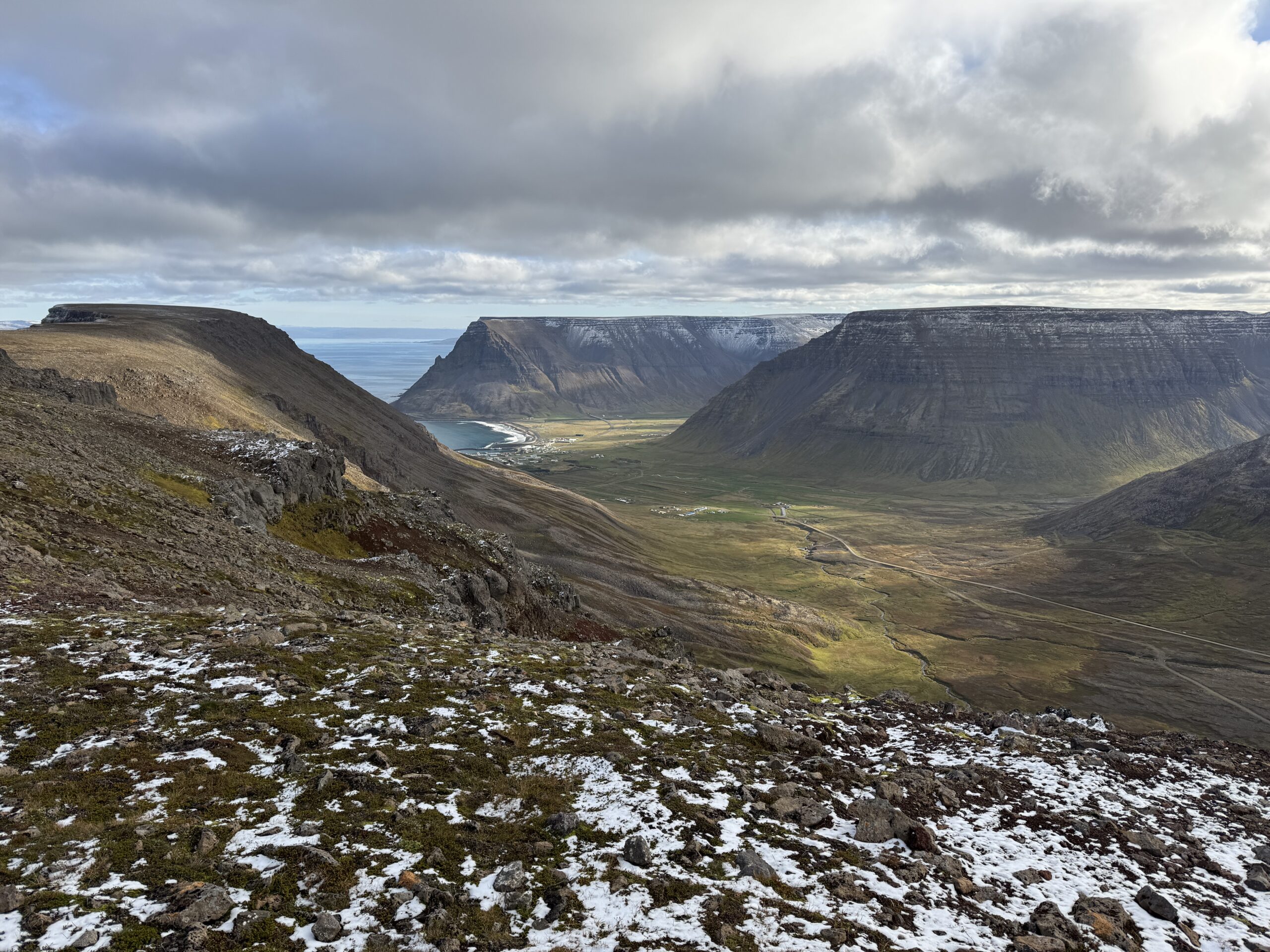
These views are from the top of the mountain Bolafjall. The radar station up there was built as a NATO project and is now operated by the Icelandic Coast Guard.

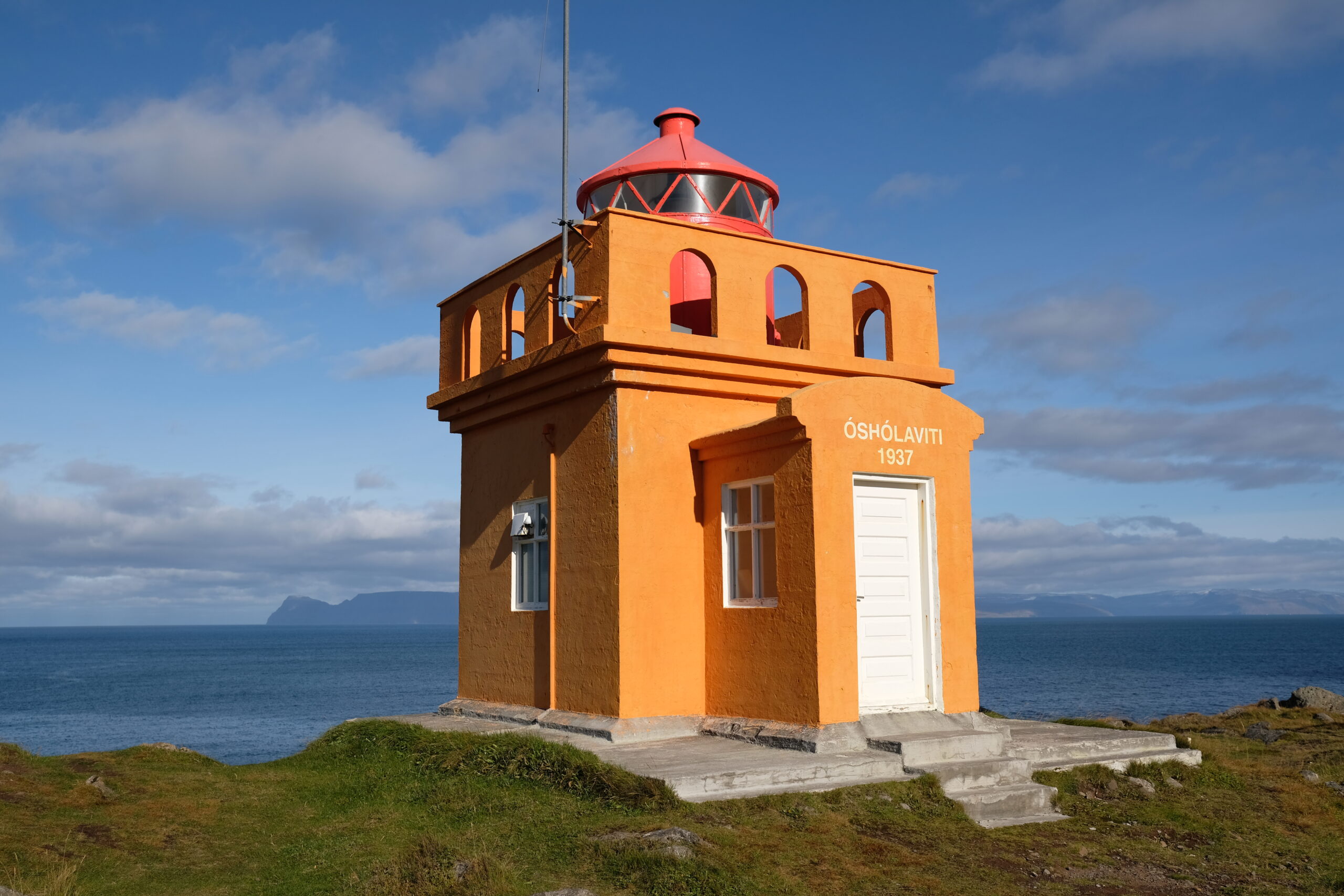
I am, of course, a fan of lighthouses and this is a fine specimen. Not all the lighthouses in Iceland are orange, but it’s a fairly common color.

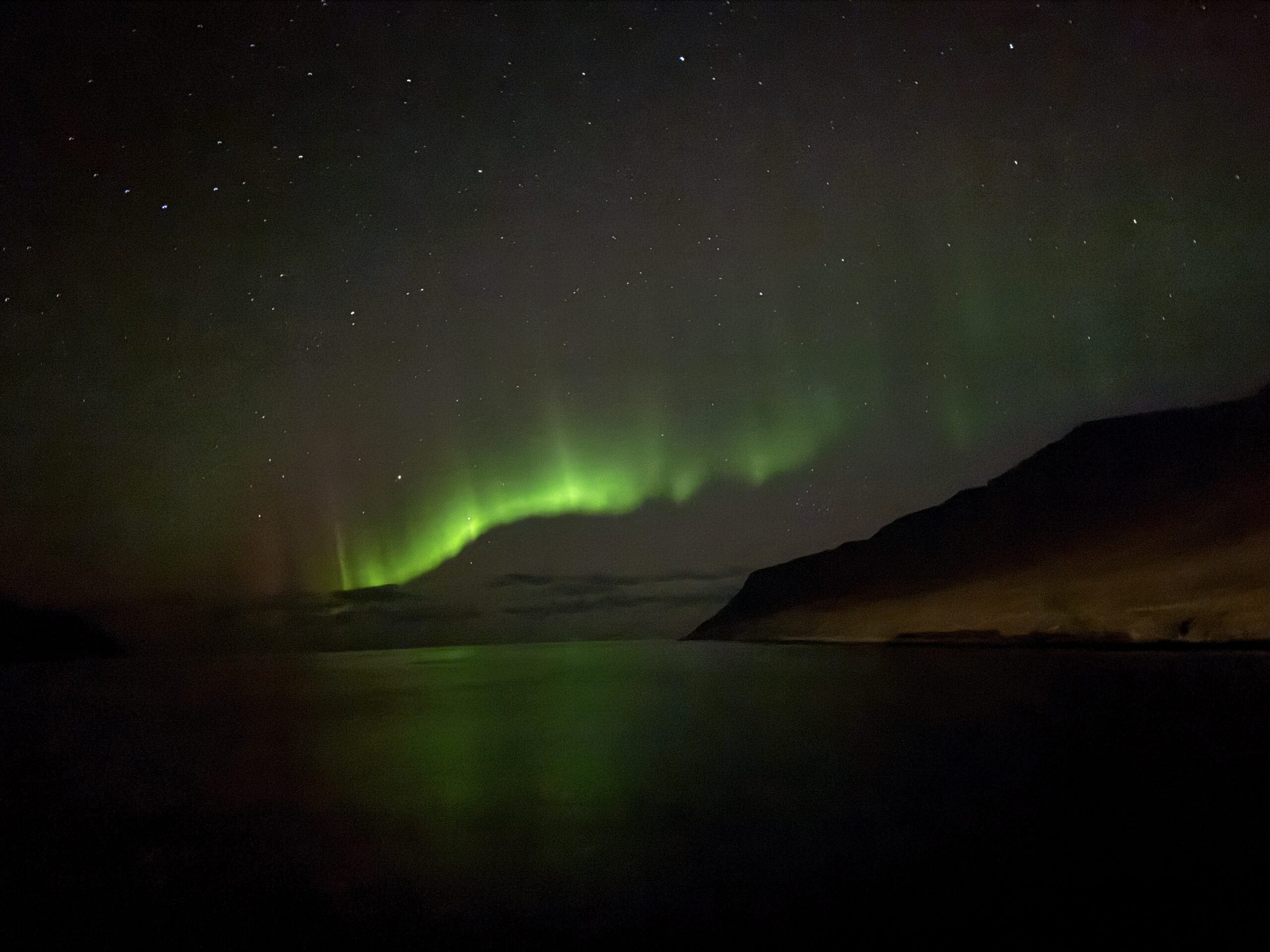
I saw the Northern Lights! I’ve seen them in Reykjavík, but this was on another level. They were much more visible to the naked eye, and I watched them dance around for about 45 minutes until it got too cold to stay out anymore. This was in Flateryi, and they were bright enough to reflect on the water near the village seawall. The aurora forecast wasn’t very strong, but on a very clear night there’s always a chance. An added bonus was the backdrop of so many stars, the kind of immersive astronomical view you can only get in such a remote place.

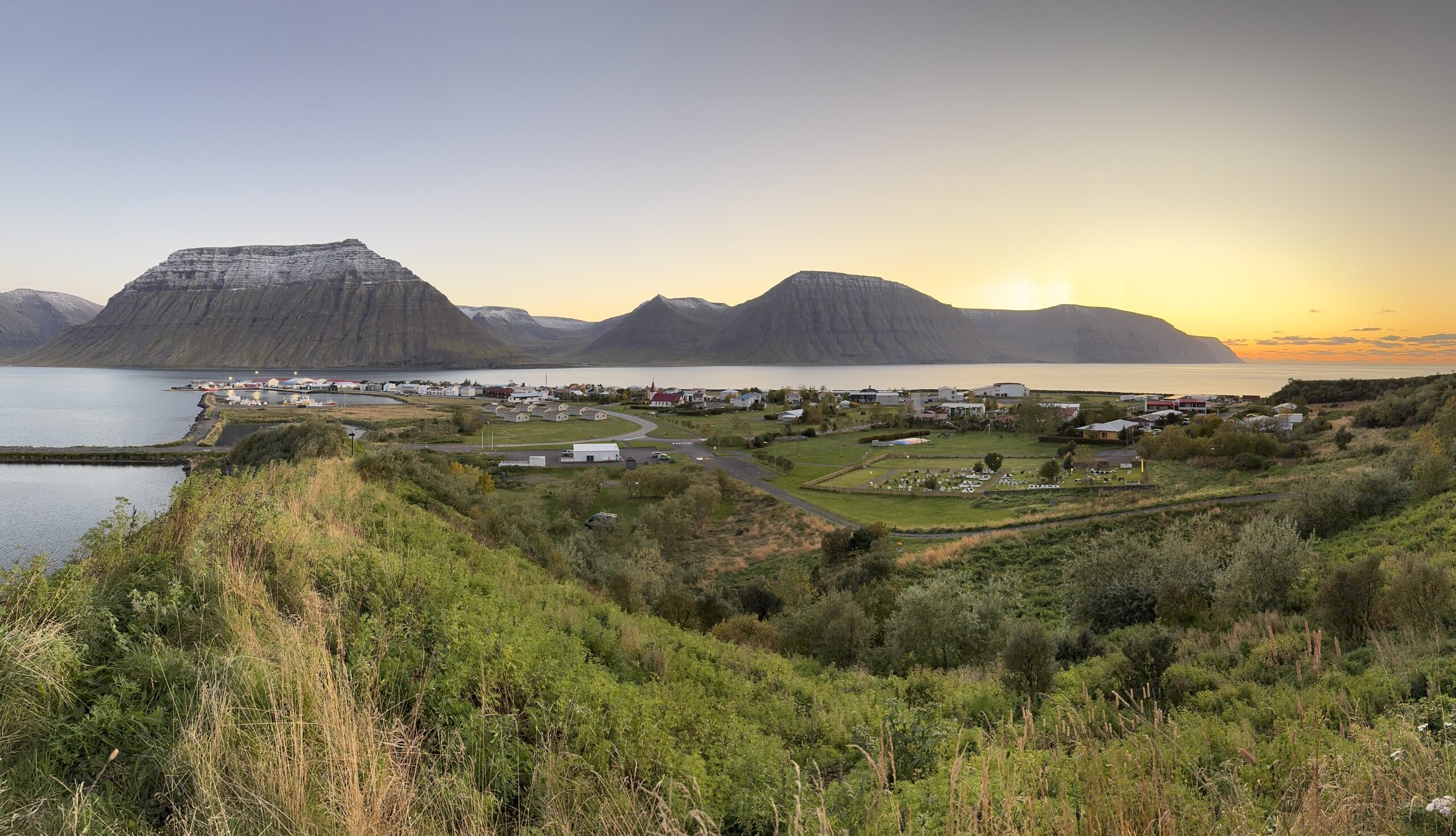
Flateryi is a interesting little village where I spent two nights. This photo is taken from atop the avalanche barriers above the town. These barriers were initially built after an avalanche in 1995 killed 20 people (approximately 10% of the town). There was another avalanche in 2020, and these barriers successfully diverted the debris away from the village, but it landed in the harbor and caused a tsunami that destroyed numerous boats. I’m not sure how the current work is meant to improve upon this infrastructure, but it’s a multi-year construction project managed by Lithuanian workers living in temporary housing set up on the edge of town. My understanding is that it’s slow going since they can only make progress during the summer months.

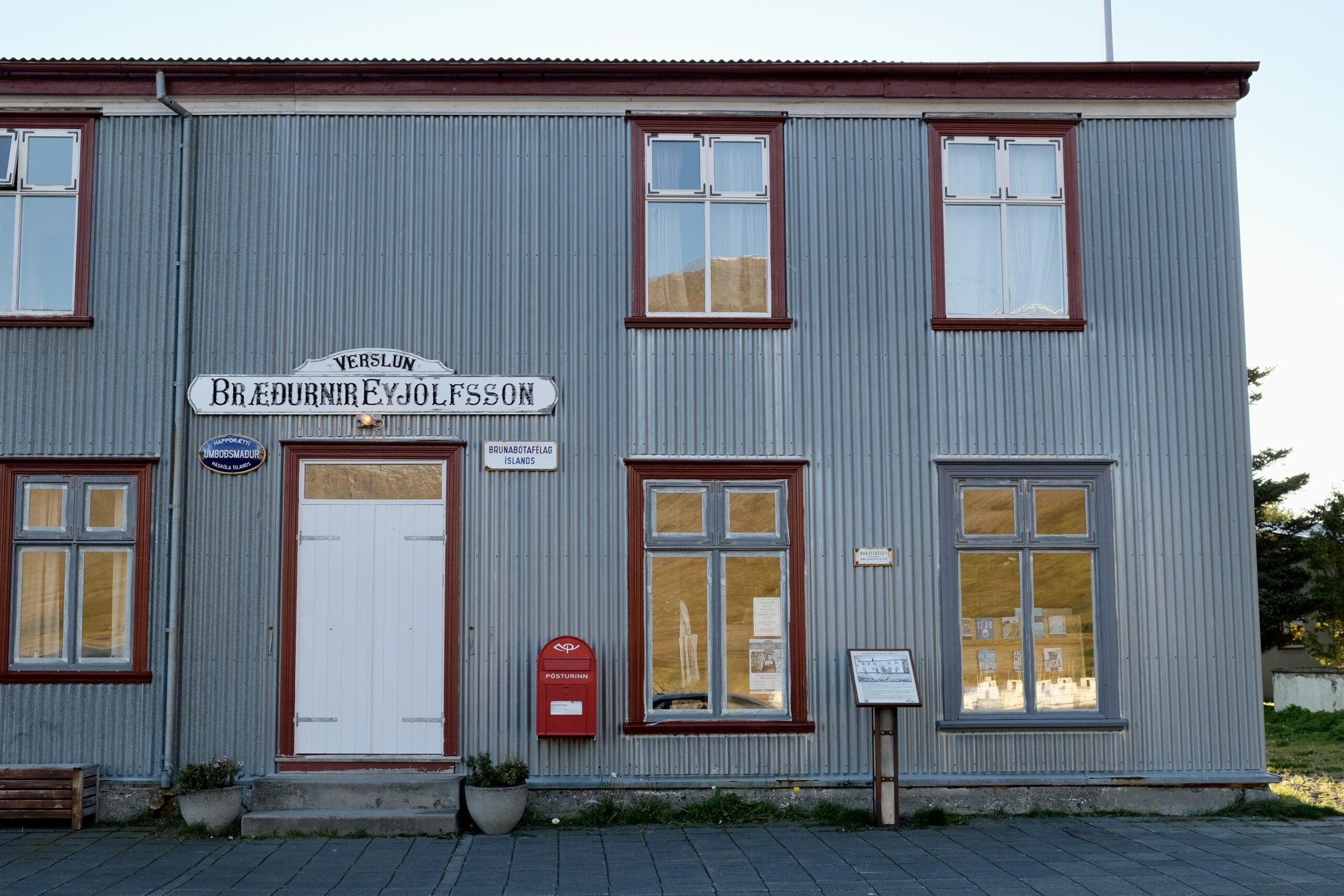
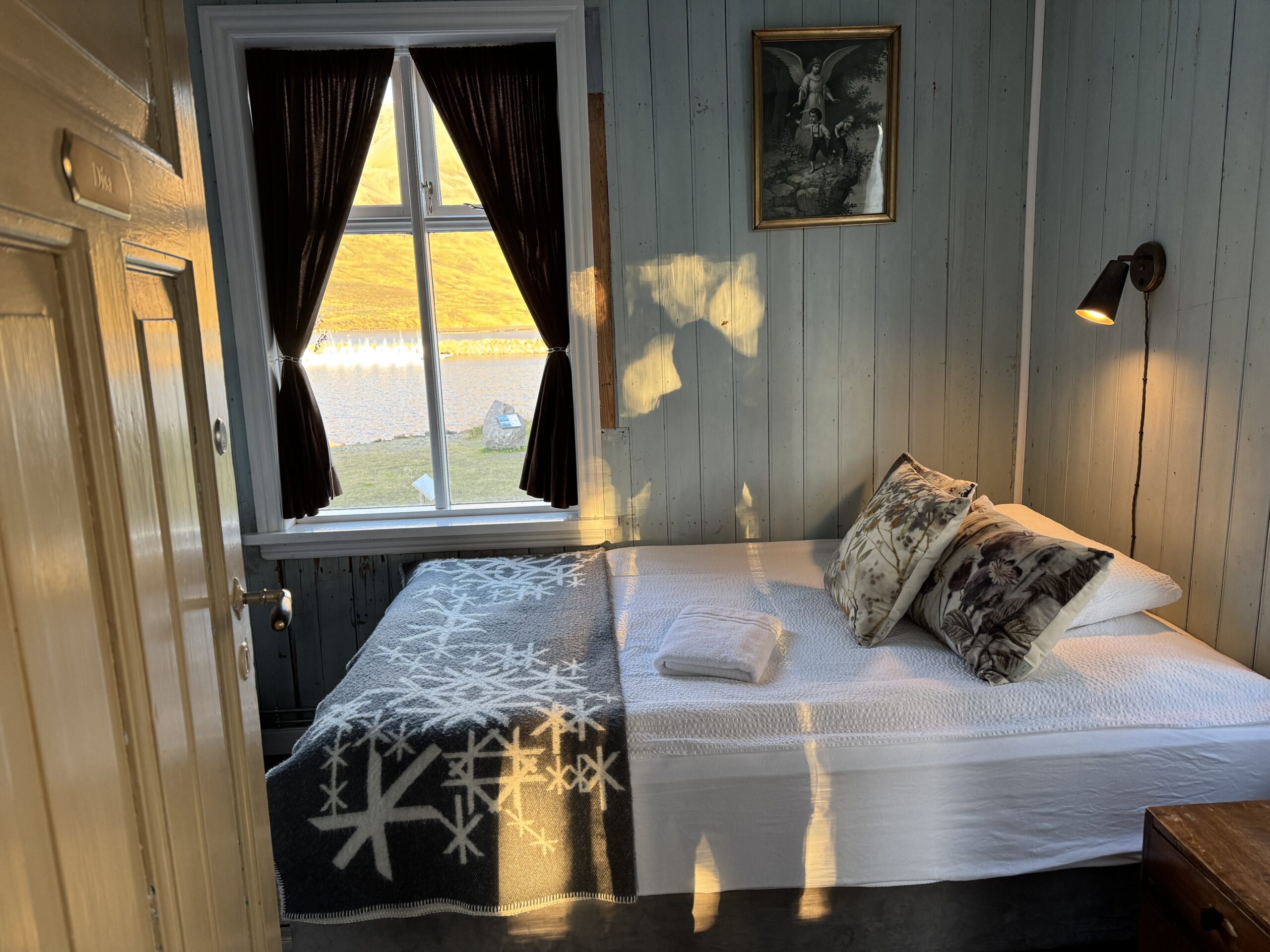
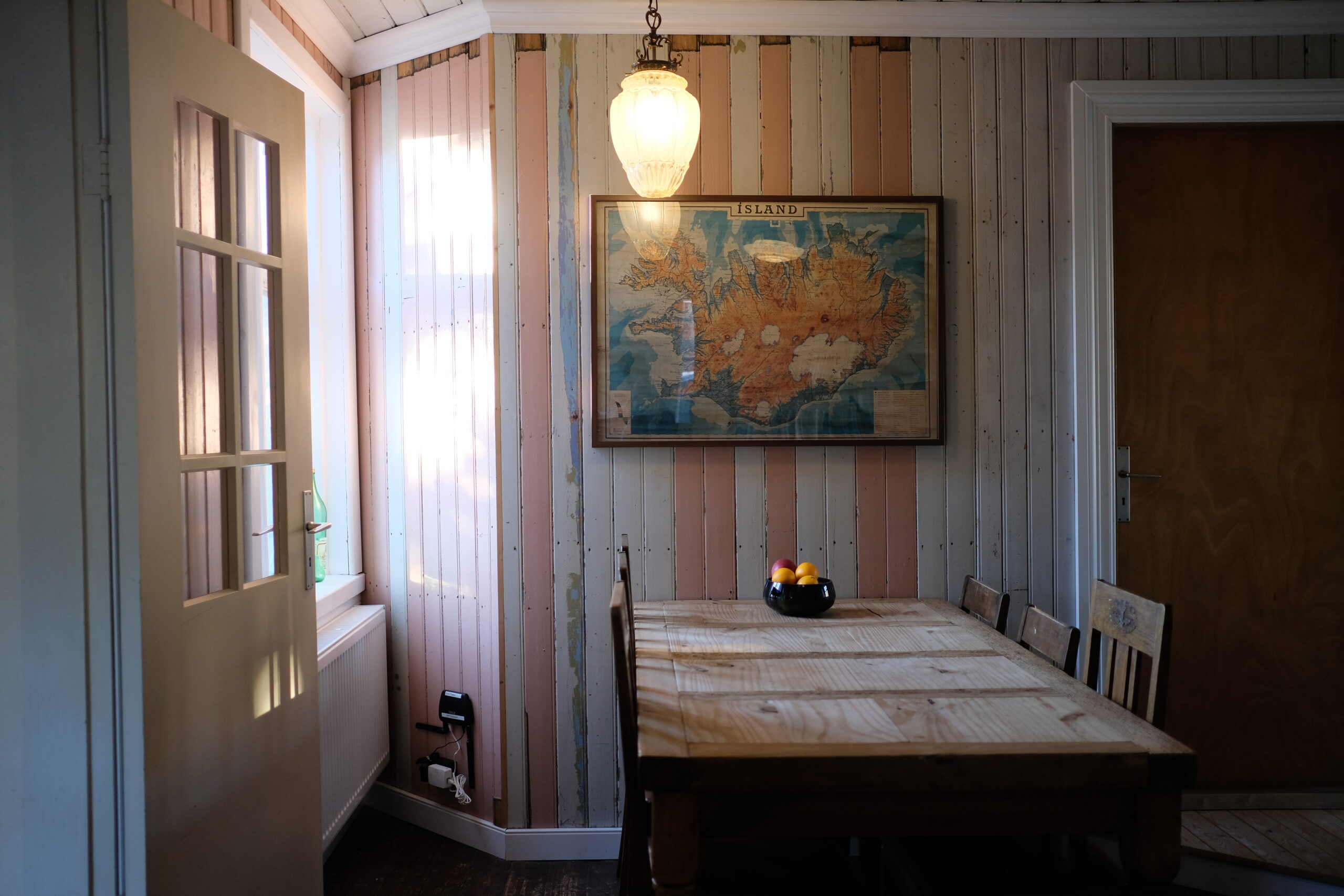
Flateryi is also home to the oldest bookstore in Iceland, and I stayed in one of the three guest rooms above the store. It’s has been run by members of the same family since 1914, and the first floor includes a museum that preserves the house exactly as it was when the current proprietor’s grandparents lived there. The upstairs is also a bit frozen in time (in a good way). Each guest room is named for the child who originally occupied it; I stayed in Dísa’s bedroom.

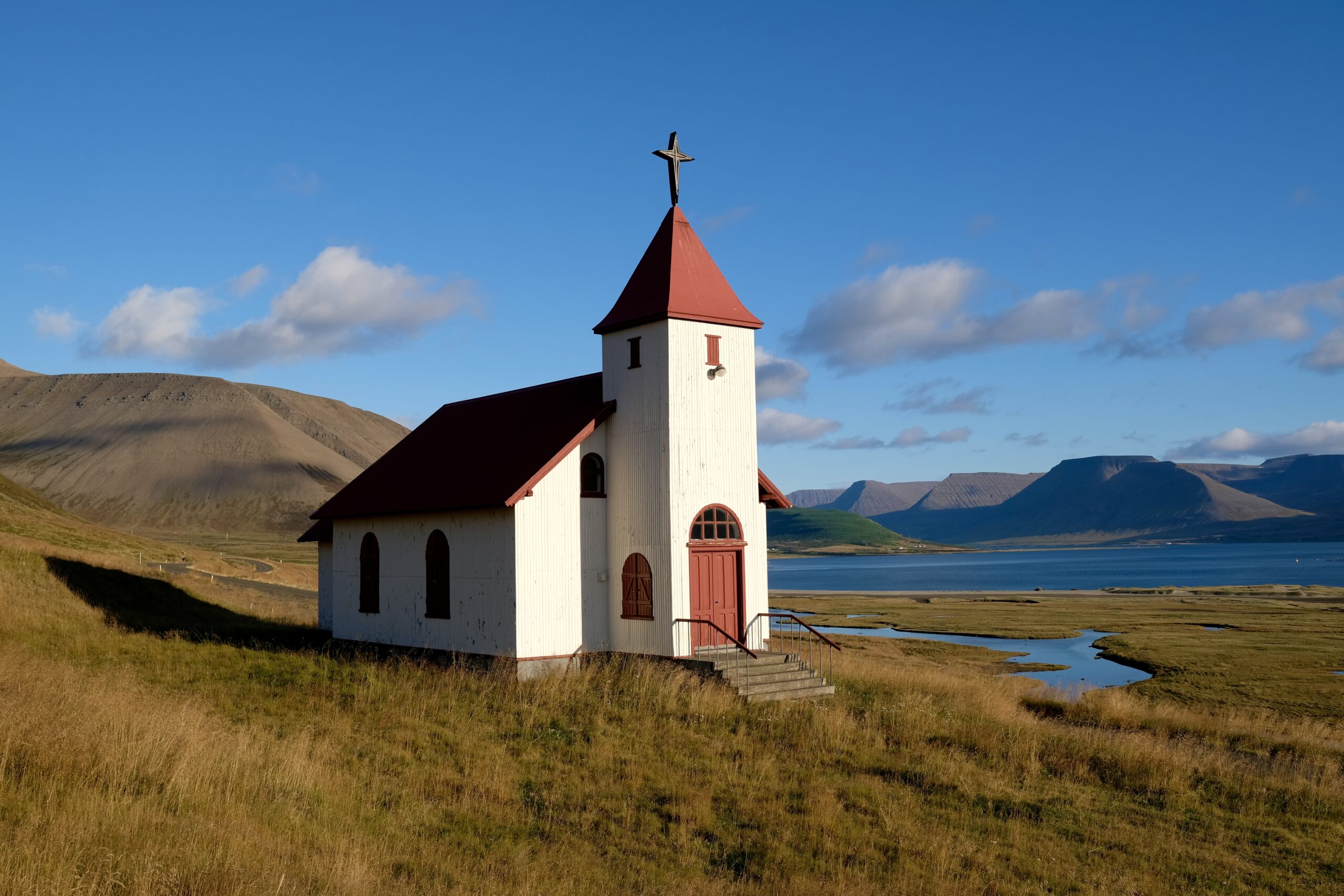
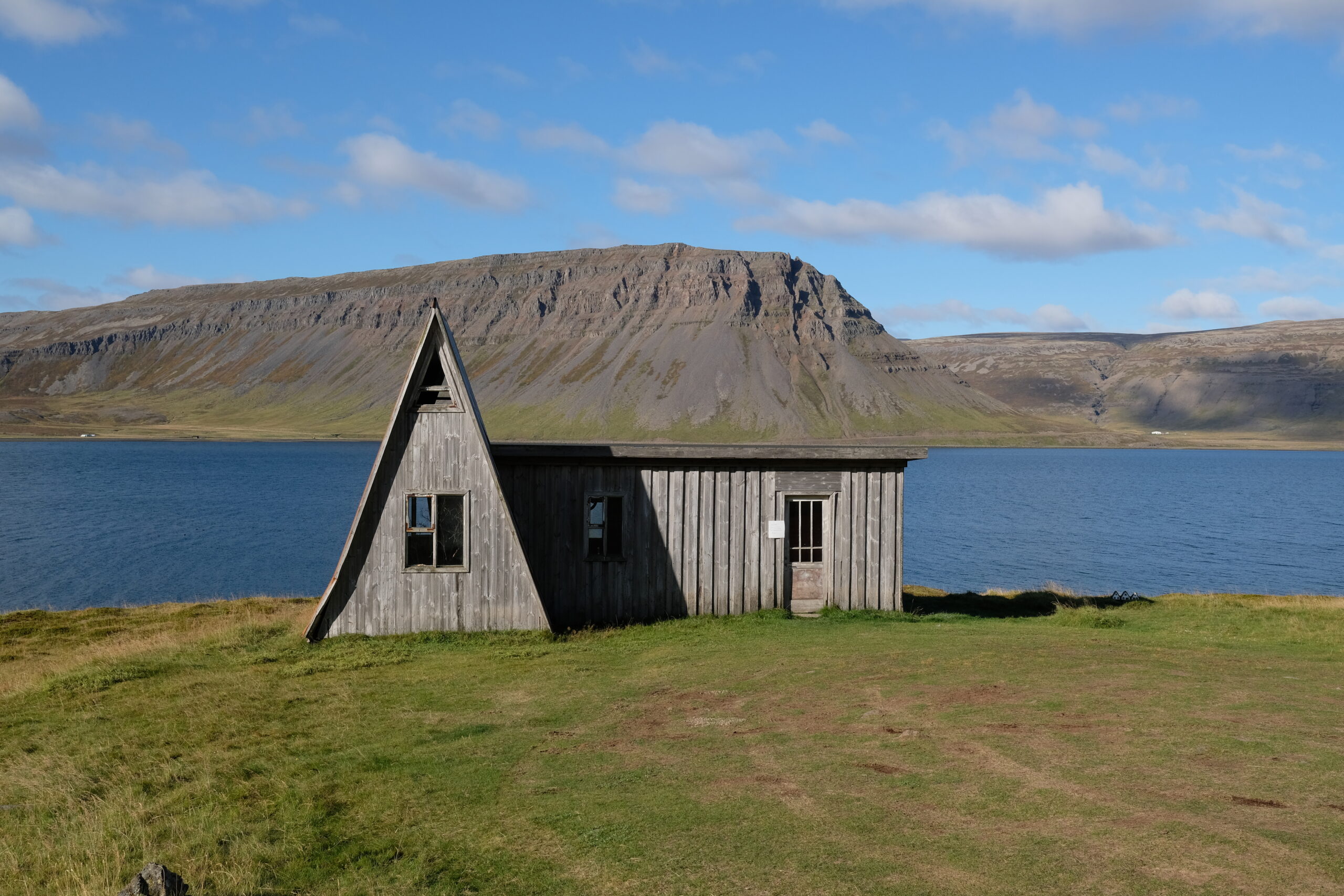
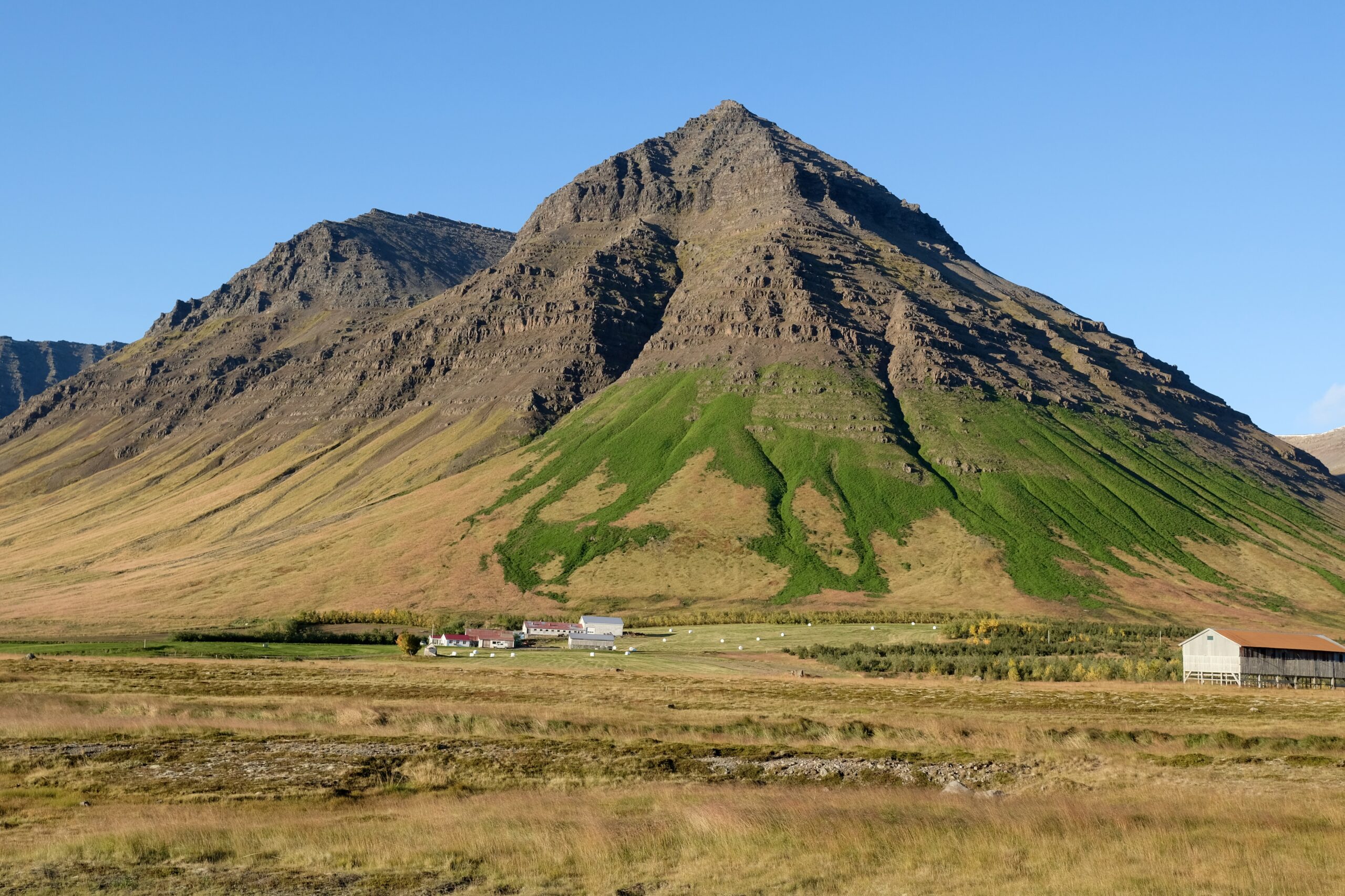
And then of course there were the endless landscapes, and the buildings in them, that in their starkness and simplicity let you appreciate the landscape even more.

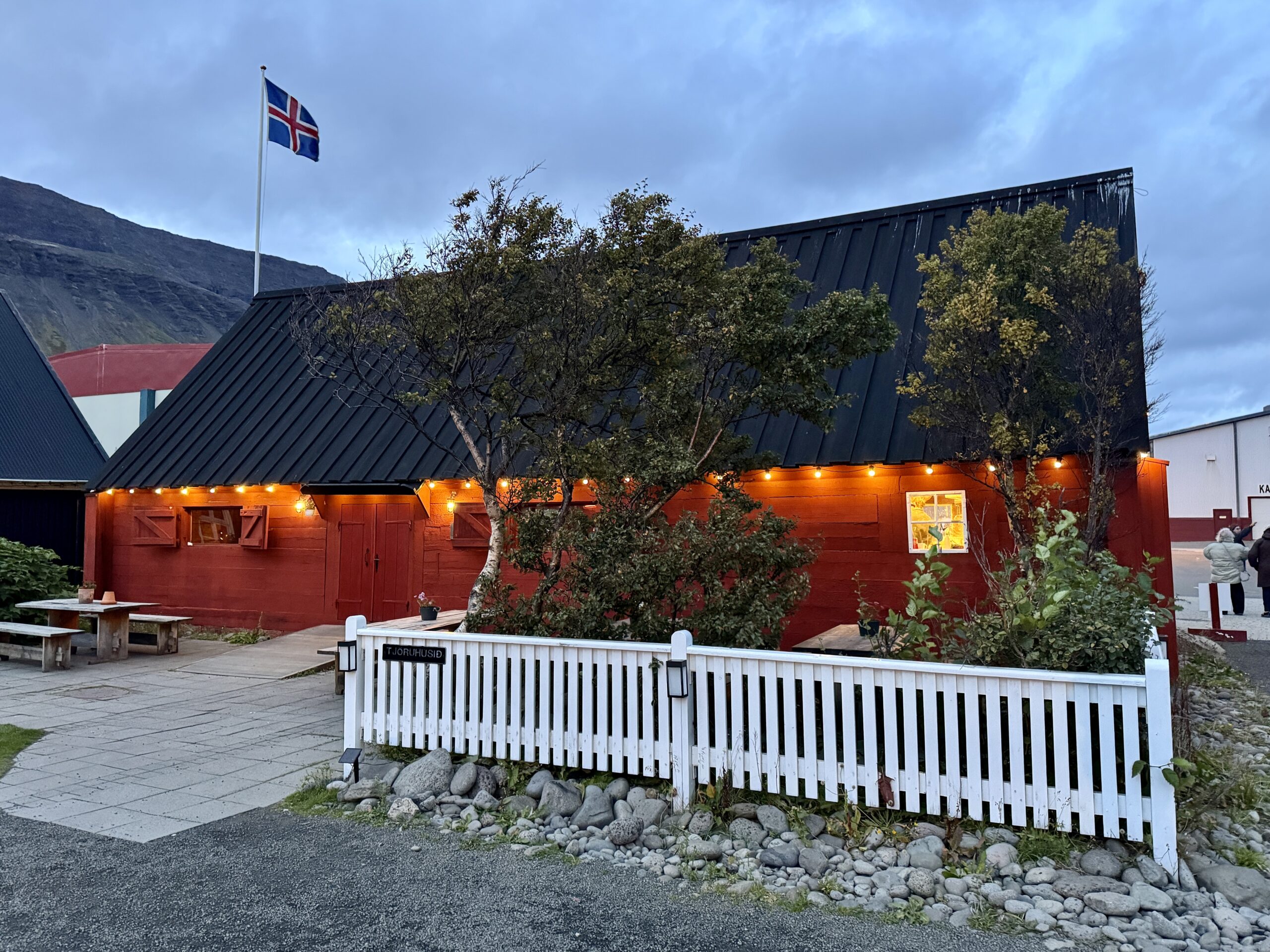
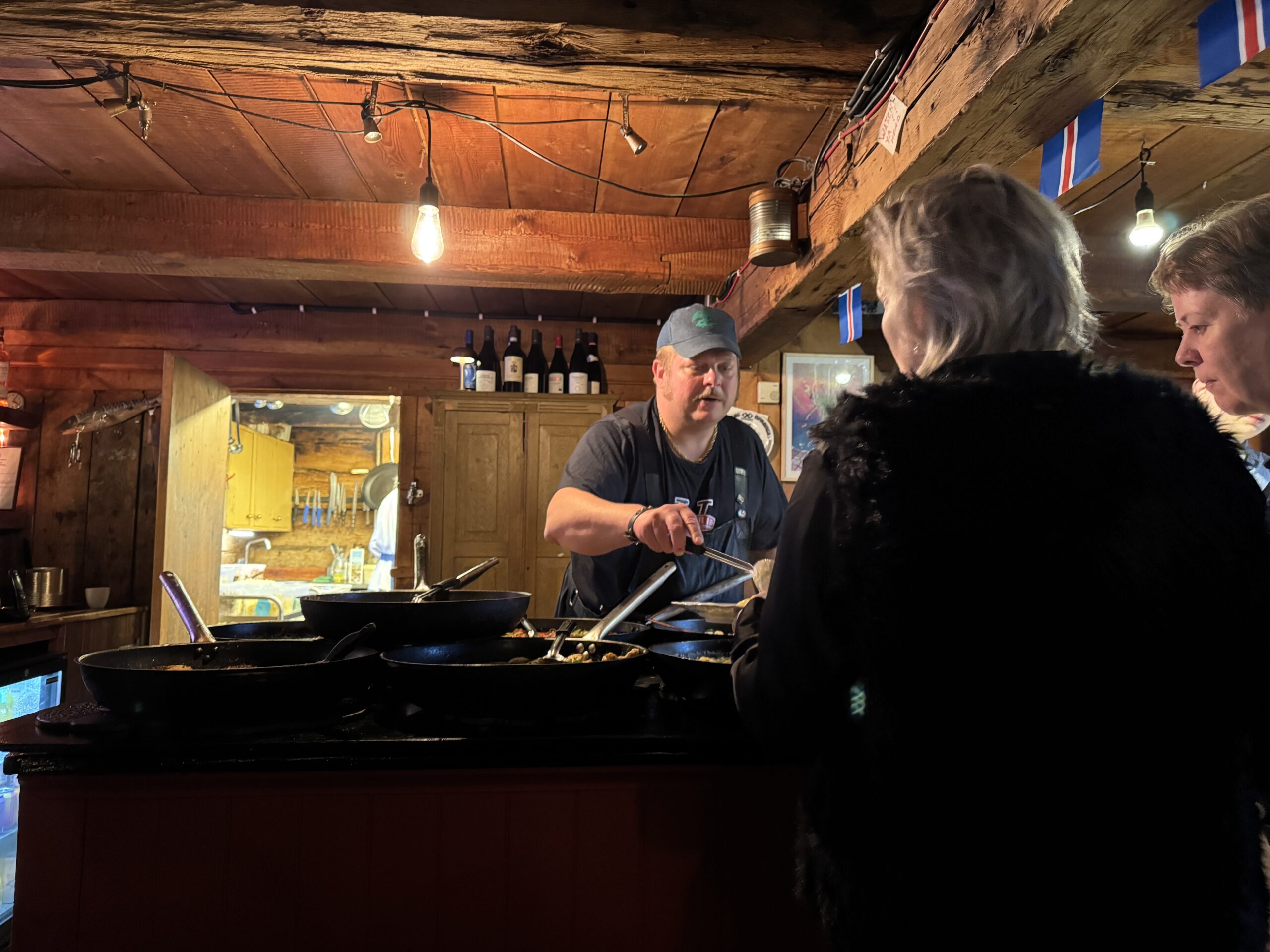
My last night in the Westfjords I had dinner at Tjöruhúsið in Ísafjörður. It’s been hailed as the best fish restaurant in Iceland, and while I haven’t tried enough of them to compare I will say that it was very good. Their website makes me laugh, as it basically just says lists their contact info and literally says “we are not very interested in marketing, or the internet in general.” I have to respect that.

The restaurant is housed in a building built in 1781. The ceilings are low, they have communal at large tables, and food is served as a buffet. They prepare around 8 different fish preparations in giant skillets and you can eat as much as you’d like. One thing I really appreciated is that they were thoughtful in seating me next to other solo travelers, which made it easier for us to have an interesting dinner conversation.

I may share more in future posts as I have many more photos and things I could say about the Westfjords. It’s truly a special place.

Noted & Done