Iceland: Week 33

In a week that included the first day of spring, the weather in Iceland was still very much winter. As usual, it’s the wind that makes things harsh, reaching over 45 MPH and causing yellow travel warnings across much of the country. In less than two weeks I have a trip to Akureyri planned during Easter break, so I’m crossing my fingers that things improve.

Luckily there were some indoor activities to check out. The Stockfish Film Festival kicked off, and is conveniently held across the street from my apartment at Bíó Paradís. Yesterday, I went to two sessions, both focused on Icelandic shorts: five documentaries and six narrative shorts, each including a Q&A with the filmmakers. At least half of the films were directed by film students studying at the Iceland Academy of the Arts. I don’t know how it works at other film schools, but it was impressive to hear about the level of financial and expert support they receive. It sounds like there are people on staff to support lighting, sound — even intimacy coordination — during 10–12 hour shooting days, sometimes in remote locations. Film is one of the creative industries where Iceland punches above its weight, and this was a glimpse into the educational foundation that makes that possible.

It’s not just film students who are well supported. Earlier in the week I attended a lecture by Jens Schildt, a Swedish graphic designer who did extensive archival research into the Swedish business equipment company FACIT. His work is fascinating, and involved recreating some of the company’s typefaces and publishing a book. Because his collaborator was living in the Netherlands they were able to tap into generous Dutch funding for this kind of design project.

His lecture (also at Bíó Paradís) was organized by Iceland University of the Arts and the Association of Icelandic Graphic Designers. While talking to one of the design instructors, he mentioned receiving Erasmus funding to take his entire class of graphic design students on a trip to Belgium. Europe has always had more funding for the arts, but the contrast with America (especially under Trump) is so stark. Imagine living in a society that supports and rewards creative activities that don’t have an obvious commercial profit motive?

Jens Schildt presenting his archival research on FACIT at Bíó Paradís

March 18 marked the 100-year anniversary of Iceland’s first radio broadcast, and I attended the opening of an exhibition celebrating that milestone in the building where it happened. Loftskeytastöðin, which translates simply to “the radio station,” is a small building on the University of Iceland campus that I walk by multiple times a week. The main floor has a permanent exhibition dedicated to Vigdís Finnbogadóttir, the first woman president of Iceland, but the basement has rotating exhibitions.

There was a collection of some of the first radio receivers in Iceland, often with a unique story of how they came to the country. For example, one of the old shortwave radios belonged to a farmer who had taught himself German and wanted to listen to broadcasts from abroad to improve his language skills. Overall, the exhibition is small but interesting. I would have liked more information on the history of the building and broadcasting, but it focuses more on tangible artifacts from the history of radio.

Architectural detail on Loftskeytastöðin, the old radio station building.
I do, of course, love the design of old radios, particularly shortwave models with city selectors.

Finally, I attended the opening performance for Harmonic Tremor by Ben Frost and Francesco Fabris at The Living Art Museum. The installation is set up as a series of upward-facing speaker cones, filled with lava collected from eruption sites on the Reykjanes peninsula. As the speakers vibrate, the lava shifts and bounces, slowly escaping the cone to create a pile of dust surrounding the speaker stand on the gallery floor. These eight speakers were augmented by many others throughout the space.

The performance was composed from field recordings made at the eruption site, including sound recorded from contact microphones placed directly on cooling lava. It felt like you were inside the eruption itself: ethereal, immense, at times startling. I’ve followed both of these artists for years, but never seen them perform, so I feel lucky to have been able to attend such an immersive joint performance. It felt like a very Icelandic experience to walk back home, in 40+ MPH wind and snow, after attending a sound performance based on nearby volcanic eruptions.

Harmonic Tremor installation by Ben Frost and Francesco Fabris at The Living Art Museum.

Iceland: Week 5

After three weeks of various adventures to the countryside my step count was considerably more modest this week. I got my first haircut in Iceland, which might just complete the checklist of day-to-day life things to figure out, and I was out and about in Reykjavík, but not too far afield. I’m really glad I was able to move here with this five-week buffer before the start of the semester. I’ve seen amazing landscapes, I’m familiar with the city, and now I’m ready to start my grad program.

As a reminder, I’m enrolled in a 1-year graduate program in International Affairs, focusing on the Arctic. That focus shaped my course selection, and I’ve mapped my first semester to largely overlap the shorter micro-credential in Arctic Studies. One consequence of that is that I needed to overload: I’m currently registered for 40 ECTS instead of the typical 30. I can re-evaluate that within the first couple of weeks, but since some of the courses are mandatory I’d have to drop the ones I’m most interested in, so I’m inclined to try and make it work.

If you’re from the US, you might be scratching your head about “ECTS,” like I was when I first started looking at this program. The European Credit Transfer and Accumulation System is a standard across academia in Europe, and they’re calculated a bit differently than the US “credit” system. One ECTS is supposed to equal 25–30 hours of student workload (per semester), counting time both inside and outside the classroom. Whereas in the US, each credit maps to an hour spent in class. Most back of the envelope conversions I’ve seen claim that 2 ECTS is roughly equal to 1 US credit, but ¯\_(ツ)_/¯ — seems fuzzy.

Anyway, here’s what I’m planning to take this semester:

One note is that The Arctic Circle is sort of a mini-course centered around the Arctic Circle Assembly, held in Reykjavík October 16–18. This is the main international forum for Arctic topics, which I would be attending anyway. I’m viewing this less as a extra course and more as a way to ensure that I get the most out of the conference. Aside from that anomaly, the other six classes meet once a week for anywhere between 1.5 and 3 hours. I have classes on campus every weekday except Tuesday.

I had a moment this week when I realized I really needed to figure out an organizational system to manage all the readings I’ll be doing. I felt much better after I remembered and reinstalled Zotero, a free and open-source application which lets you organize documents, associate them with notes, and manage citations. It converts PDF highlights, syncs everything between Mac and iOS, integrates with Google Docs, and keeps track of your spot in a PDF when you switch devices. I feel dumb for not using this when I wrote my book.

If you have suggestions for other tools to help me manage my research, writing, schedule, or all-the-other-things, please send them my way. The last time I started a graduate program was 20 years ago, I’m sure things have changed a little bit.


For the last decade, by shear coincidence, I’ve lived in very close walking distance to a movie theatre. In Pittsburgh the Row House Cinema was less than a block down the hill, in Minneapolis I could walk to the Edina 4 in 10 minutes, and now in Reykjavík I find myself living half a block from Bíó Paradís. What makes this latest cinema situation so great is that I’m a big fan of Icelandic films, but normally have to wait for years after their release to see them, scrounging for access in the dark corners of the Internet or subscribing to niche streaming services. But this week, given my newfound proximity and geography, I saw two recent releases that thankfully aired with English subtitles.

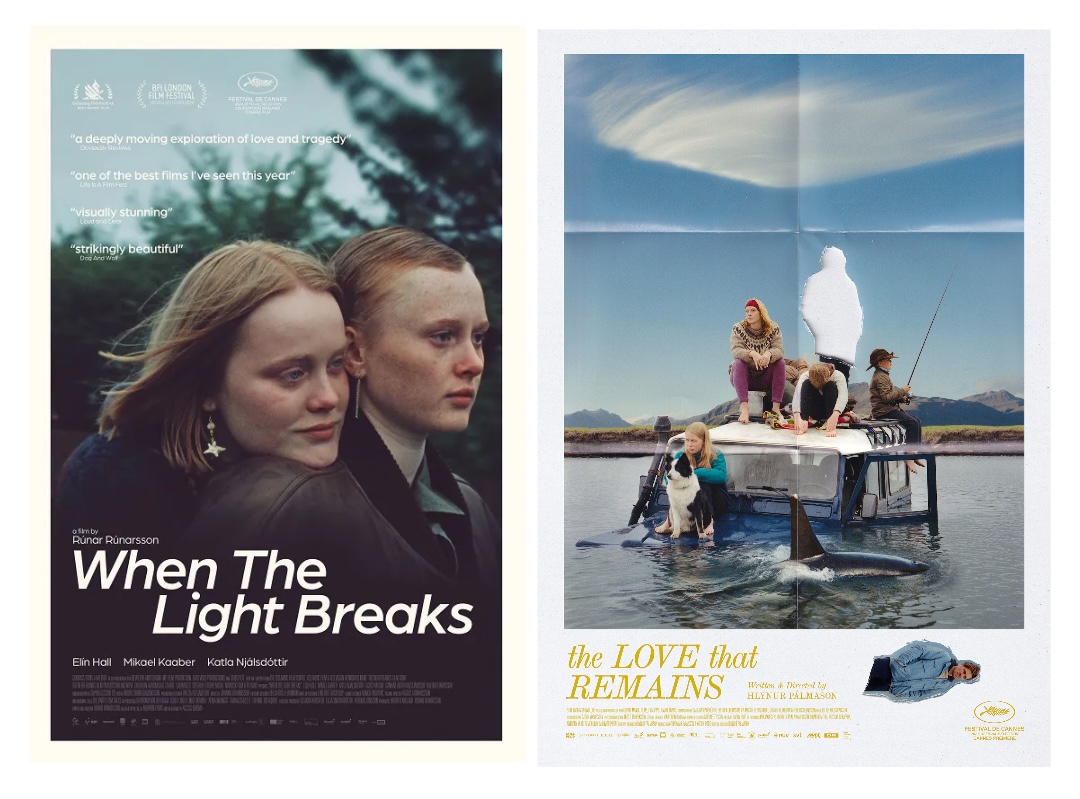
The first was When The Light Breaks (trailer), directed by Rúnar Rúnarsson, which came out last year. It centers on a small group of friends, two intertwined relationships, and an unexpected tragedy. It’s shot entirely in Reykjavík, much of it at the Iceland University of the Arts and Harpa, so it was fun to recognize the locations throughout.

The second film was The Love That Remains (IMDB), written and directed by Hlynur Pálmason, which was actually its Icelandic debut after premiering at Cannes in May. This is the fourth film I’ve seen by this director, and it was interesting how he incorporated a similar technique used in the 2022 short Nest to convey the passage of time. Like that film, there are shots where the camera captures an outdoor scene from a fixed point-of-view, and flashes between drastically different weather conditions that the Icelandic countryside so easily provides. Both films take place over a year, and these temporal jump cuts are interspersed with slowly unfolding scenes of everyday family and work life. He has a beautiful, simple, quiet storytelling style that showcases the story’s environments, both manmade and natural, alongside his characters’ complex relationships. There were also some metaphorical/supernatural elements, which I’m less sure about, but overall I thought it was great.

At Cannes, The Love That Remains won an award that I didn’t know existed but that I’ll be tracking from now on — The Palme Dog! More specifically this award goes to Panda, an Icelandic Sheepdog that steals scenes throughout the film. The best part is that Panda isn’t a trained actor, but the director’s longtime pet, probably not sure exactly what a film is, but always happy to be involved.

I created a list on Letterboxd to keep track of Icelandic films that I’ve both seen, and want to watch. Let me know if you have any recommendations that I haven’t added yet.


Noted & Done

  • Got my first haircut in Iceland, by a Greenlandic barber. I apologized on behalf of the US, although he was convinced that nothing would come of Trump’s rhetoric of making Greenland part of America. He actually thought the attention that Greenland’s been getting could have positive outcomes. I hope he’s right.
  • Realized that my electric tea kettle here boils water noticeably faster than in the US. because it can pull more watts from the higher-voltage supply. Relatedly, I also realized that I need to buy a new induction charger for my electric toothbrush because my US version is only rated up to 130V. It hasn’t caught on fire yet, but I really don’t like using the word yet in the same sentence as fire.
  • Saw Autechre perform at Harpa, in complete darkness. Honestly, the darkness and the unrelenting aural assault that is their live show was a bit overwhelming and claustrophobic. I think that a seated venue would have made it easier to take in.
  • Saw GRÓA play at Smekkleysa.
  • Went to RVK Poetics at Mengi, a recurring reading event. Over half were in English, so worth checking out again.
  • Went to an event at Hönnunarsafn Íslands, the Museum of Design and Applied Art. Small but interesting collection of Icelandic designs across a variety of mediums.
  • Went to the Nauthólsvík Geothermal Beach, which I learned is not one of the places my pool pass works, but cold plunging in the ocean is fun.
  • Did my first “vibe coding” with ChatGPT to create a script that scrapes concerts from Setlist.is and creates an iCal file I can subscribe to in Google Calendar. It works, took less than an hour total, and I wrote zero lines of codes.
  • Finished the book The Arctic: What Everyone Needs to Know (full PDF).