Iceland: Week 40 (& London)

My week started and ended in Iceland, but in between I spent four days in London, going to museums, taking lots of trains, drinking great coffee, and walking over 30 miles. It was nice to be in a giant city again, to feel the energy and possibilities that, for all its charm, are not part of life in Reykjavík. Also, while I know that London is not known for its weather, it was quite a bit warmer, and it was nice to wander around without the need for a hat and scarf.


One of the days I took the regional train northwest of the city to visit The National Museum of Computing, which has been on my list for a while. It’s housed on the campus of Bletchley Park, which was home to the British codebreakers during WW2. That’s where they worked in secrecy to decipher coded messages sent by the Nazis, which required reverse-engineering the Germans’ encryption machines. Most of the computers they created to do this were destroyed after the war, but TNMOC houses working authentic recreations alongside a broader collection of large-scale systems and personal computers. It’s a fascinating place, and the volunteers do an excellent job explaining how it all works. I didn’t make it to the rest of Bletchley Park, which is actually the much larger museum campus. They are two separate organizations, and had a bit of a falling out years ago around the time that Bletchley Park got a large grant. It seems that TNMOC is the place to go for a more technical history, whereas Bletchley Park is more about life during that period. It would have been interesting to do both, but since I only had time for one I chose to see the working recreation of Colossus over where Alan Turing used to sleep.

The Enigma machine. One thing I didn’t realize is that these were fairly common in Germany at the time, and actually marketed to the private sector to do things like send messages between banks. Although in wartime additions were made to increase the number of possible settings.
Detail of the Bombe, which was used to decrypt Enigma messages.
Colossus is the world’s first programmable electronic digital computer, and helped with the cryptanalysis of the Lorenz cipher.

I also got to go to the Transport Museum Depot at Acton, a large warehouse that stores over 320,000 historical items from London’s transport history, from posters and signage to trains and buses. While there is a smaller museum open most days, this full archive is only accessible to the public on select weekends or by booking a guided tour.

Type samples of the Johnston typeface used throughout the system. Below are rolls of moquette, different patterned upholstery used on train and bus seats.
Old switching equipment for the Elephant & Castle station

Those two museums were the bookends of my trip, but I also went to the Design Museum, the Grant Museum of Zoology, Sir John Soane’s Museum, the Tate Modern, and the Treasures of the British Library. Other notable stops were Novelty Automation, eating at Dishoom (twice!), an incredible concert by Makaya McCraven in an old church, and a Dadaist performance/film at the Horse Hospital. I hadn’t been to London in a long time, and most of my past trips were for work. So it was nice to wander around neighborhoods I hadn’t been to before.

One thing I found notable was how seamlessly the transport system now works with contactless payment. I never had to buy a ticket — I just tapped my credit card at the start and end of my journey, on both the Tube and the regional railways. I didn’t ride any buses, but it works the same there. The system keeps track of what zones you pass through and charges you once at the end of the day, factoring in the daily fare cap. I’m already used to the convenience of showing up in another country and not having to worry about paper currency. This takes it to the next level, where I had immediate access to public transit with no separate account, tickets, or tokens to worry about.

The Olivetti room at the Design Museum
Sir John Soane’s extremely over-the-top house museum.
A really wonderful automated diorama at Novelty Automation.
I still want to take a canal trip by narrowboat someday.

In Iceland ferry news — last week I wrote about the challenges the Vestmannaeyjar ferry was having (failed engines, harbor filled with sand, etc.). Since then, the dredging of the harbor at Landeyjahöfn went well, but this ferry company cannot catch a break! As soon as the sailings resumed, their booking system went down because of a fire in the Dutch data center that hosts their website. Luckily, I already bought a ticket for my sailing in 11 days, but given their track record, who knows what will happen before then.

Iceland: Week 35

I had a break from classes for Easter, so I decided to take a trip to the north of Iceland. I’d never been before, and while I plan to visit again at the end of May, I wanted to get the winter experience as well and see the mountains covered in snow. The weather was unpredictable right away, switching from clear skies to a yellow warning the morning I left Reykjavík. I made it to Akureyri before sunset, but not before some white-knuckle driving in whiteout conditions.

Akureyri is a great little town, the capital of the north, but with only 20,000 people. It sits on a hill, with city stairwells that reminded me a little bit of Pittsburgh. Its iconic church overlooks the downtown area, but it’s worth walking beyond it, higher up the hill, until you reach the botanical garden. Even in winter, it’s a nice place to visit, for the novelty of a patch of trees in Iceland, but there’s also a great little cafe called LYST that’s worth the visit.

I based myself in Akureyri for three nights, but went as far east as Lake Mývatn, and as far north as Siglufjörður, stopping at natural sites and towns along the way. I’m still on the road as I write this, from a hotel room in Stykkishólmur, where I stopped on my way back to Reykjavík. My plan was to spend all day tomorrow wandering around the Snæfellsnes Peninsula before returning the rental car tomorrow night, but the weather has other plans. Today’s weather was absolutely perfect, sunny and clear, with reasonable winds. But a massive storm is rolling in tomorrow morning, triggering an orange alert (meaning “do not travel”) for the capital region and the entire south coast. I’ll need to leave early in the morning to make it back, or else I’ll be stuck on Snæfellsnes.

Despite the weather challenges — which also included getting my car stuck in the snow and having to enlist the help of a German family to dig it out — it’s been a great trip. But right now, I’m far too exhausted to write in detail about it, so I’ll save that for later and just share some photos. You can find the rest on Instagram, where I have six photo sets for this trip: 1, 2, 3, 4, 5, 6.

Laurel Highlands Thru-Hike, May 2022

Over the last few years I’d had my eyes opened to the wealth of public lands in Western Pennsylvania, and enjoyed discovering all the various hiking trails. One of my favorites is the Laurel Highlands Hiking Trail, a 70-mile route from Seward to Ohiopyle that winds through State Parks, State Forests, and State Game Lands. The diverse landscapes it connects include imposing rock outcroppings, tangled rhododendron tunnels, and quiet fern-filled forests. When I started a sabbatical a few months ago there were a lot of things I needed a break from — to stop doing — but one of the few concrete goals I had was to complete a thru-hike of the Laurel Highlands.

I’d never done any overnight backpacking, so this trip required a bit of planning, learning, and training to pull off. But last week I successfully completed the 70-mile hike, and really enjoyed myself! Below are some day-by-day notes for my own documentation that might hopefully help others who are interested in planning a similar trip.

The Route

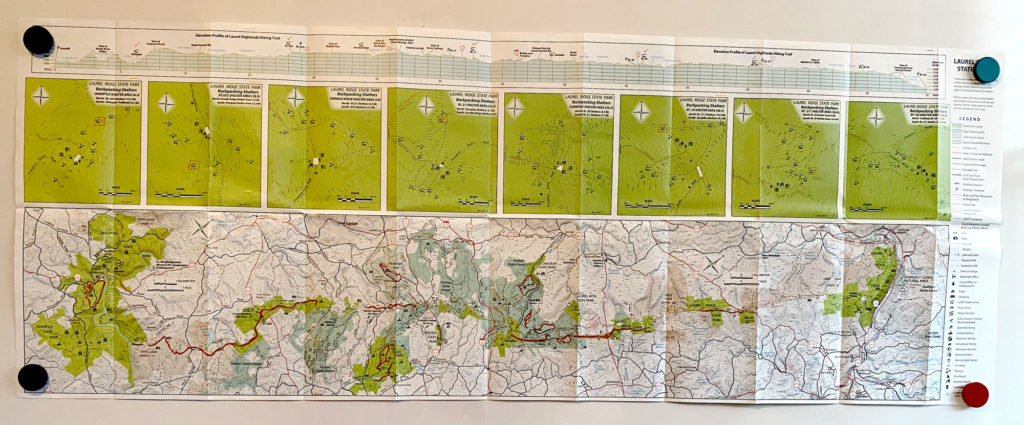
The Laurel Highlands Hiking Trail map has been hanging on my office whiteboard for over a year, where I mark off the sections that Molly and I have completed together. These are 6–8 mile out-and-back hikes, so while we’ve seen a lot of the trail it’s been fairly slow going, and difficult to fill in some of the more remote gaps.

The trail runs from Ohiopyle, PA (mile 0) to Seward, PA (mile 70) and I hiked it in reverse because the segments worked out a bit better for me and it seemed more celebratory to end in a bustling small town full of outfitters and restaurants, rather than a quiet parking lot.

One of the things that made this trip seem doable, as a first-time backpacker, are the eight different shelter areas along the trail. Each one contains a handful of three-sided Adirondack shelters with integrated fireplaces, which can be reserved ahead of time. The shelter areas are well maintained by the PA DCNR, who provide cut firewood, bear-proof trash containers, and clean outhouses.

The spacing and number of shelters allows for a variety of different itineraries, and I decided to do the hike in five nights, starting Monday morning and ending on Saturday afternoon.

Continue reading “Laurel Highlands Thru-Hike, May 2022”

Abandoned coal towns of West Virginia

The last movie I saw in a theatre, before the pandemic shut everything down, was a 4K restoration of the 1987 film Matewan at the Carnegie Science Center’s IMAX theatre. It’s a film about union labor organizing in a West Virginia coal mining town, and the violent struggle between the company and workers. It stars Will Oldham, one of my favorite musicians, in his first cinematic role. Both the director and Oldham were in person for the screening and held a Q+A after the film.

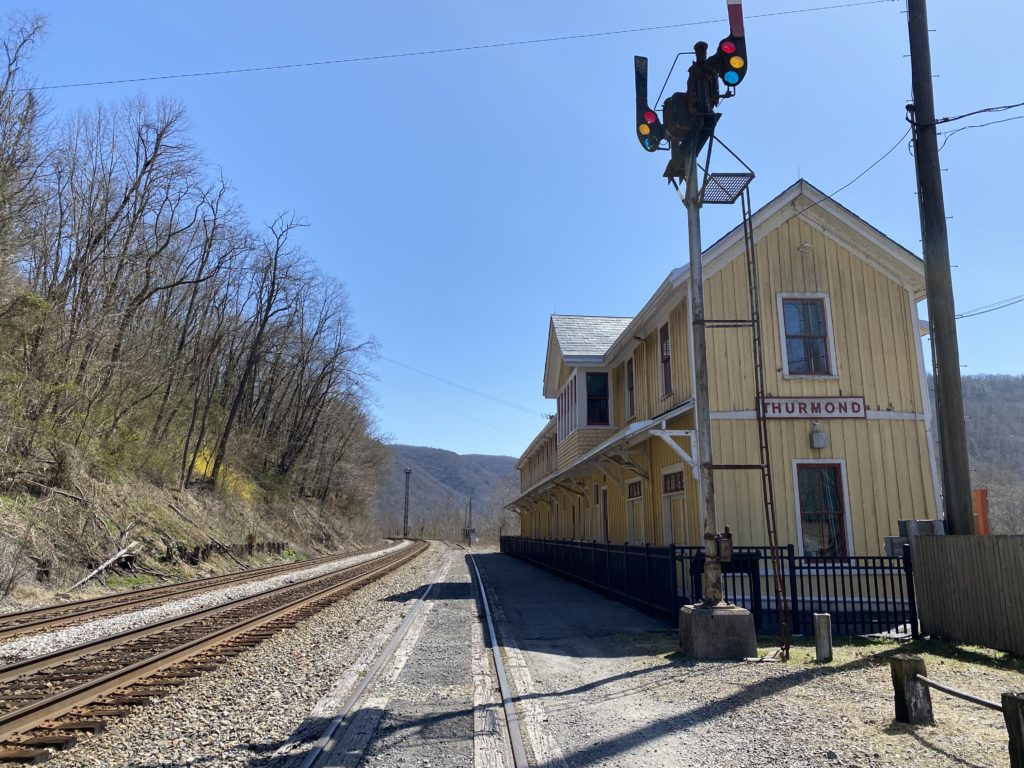
Although Matewan is a real place, the film was shot about a 100 miles northeast in the abandoned town of Thurmond, West Virginia. Both towns were built along the railroad, with the tracks in Thurmond acting as a “main street” for its commercial strip. Until 1921 those tracks were the only way to access the town, which served as a thriving hub for the local coal mining community along the New River. Thurmond’s peak was in 1910, when it supported multiple hotels, banks, and even a movie theatre. Over 75,000 people passed through the Thurmond depot that year.

A few weeks ago we visited the New River Gorge National Park, which Thurmond now sits within. After winding deep within the gorge you enter the town by crossing a one-lane railroad bridge, near a dramatic bend in the New River, to discover what is effectively a ghost town.

The Thurmond depot, built in 1904 after the 1891 original was destroyed in a fire. Thurmond remains an active Amtrak stop, so the depot is still in operation (although it was closed on the day we visited).
Continue reading “Abandoned coal towns of West Virginia”

Dear Lighthouse

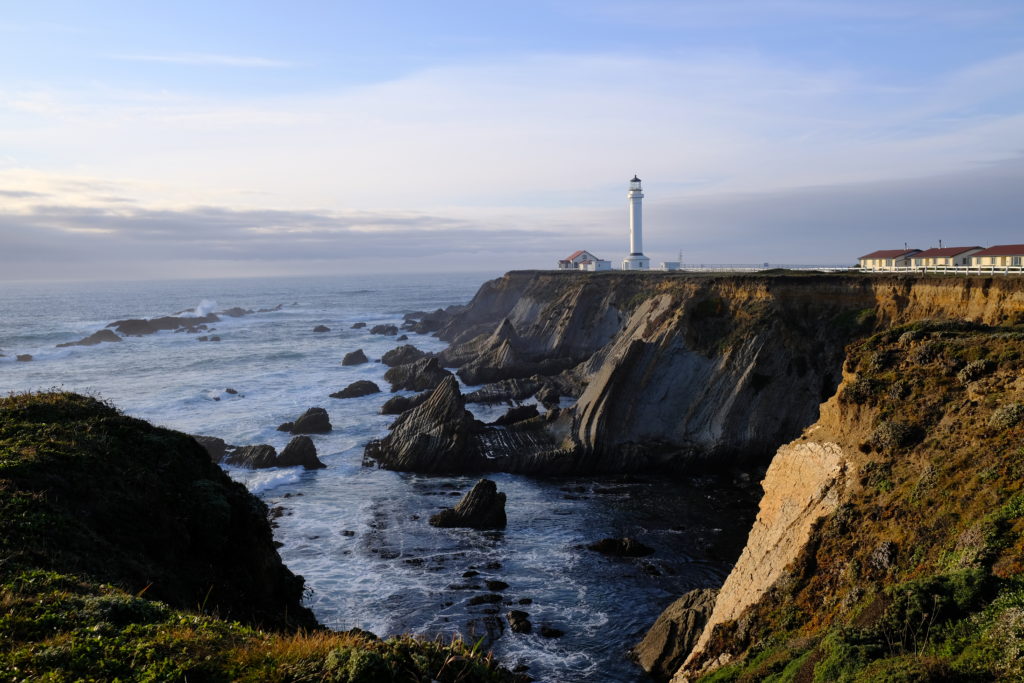
Just before lockdowns started in March of 2020, after my last week at IDEO, I took the California Zephyr from Chicago to San Francisco and spent a week in Mendocino County. I stayed in the keeper’s quarters at the Point Arena lighthouse, which is situated alongside the beautiful Stornetta Public Lands, and was lucky to have my trip coincide with a twice-yearly lens tour at the nearby Point Cabrillo lighthouse.

I had planned to meet Molly in La Paz, Mexico the following week, but we cancelled the trip and I headed home, into a year of COVID-19 shutdown and everything that followed. It’s been just over a year, and reflecting back reminds me not only of the beautiful landscapes but the sense of possibility I felt, which has been stunted by this pandemic. I’m hopeful for the return of that feeling in 2021.

Below is my submission to the Point Arena Light Station “150th + 1 Anniversary Writers Invitation” within their “Dear Lighthouse” category.

Point Arena Light Station, March 5th, 2020

Dear Lighthouse,

It’s hard to believe it’s been a year since we met. I suppose the memory is stronger for me, given the circumstances. I had just left my job, a bittersweet choice to spend less time traveling. My trip to see you was a personal interregnum, a space left intentionally blank, a time to look neither forward nor backward. I knew that change was coming, but didn’t understand the scale.

I traveled by train, a long continuous line connecting a Great Lake to a great ocean. From the observation car I watched night blanket the Midwest, and morning sun reveal the Rockies. Snow covered mountain passes gave way to red rock canyons. As we wound around the San Francisco Bay, a cruise ship was seeking permission to dock, its passengers infected with the novel coronavirus. We didn’t yet call it a pandemic, just a scary story set in other countries.

You, of course, know about the calm before the storm.

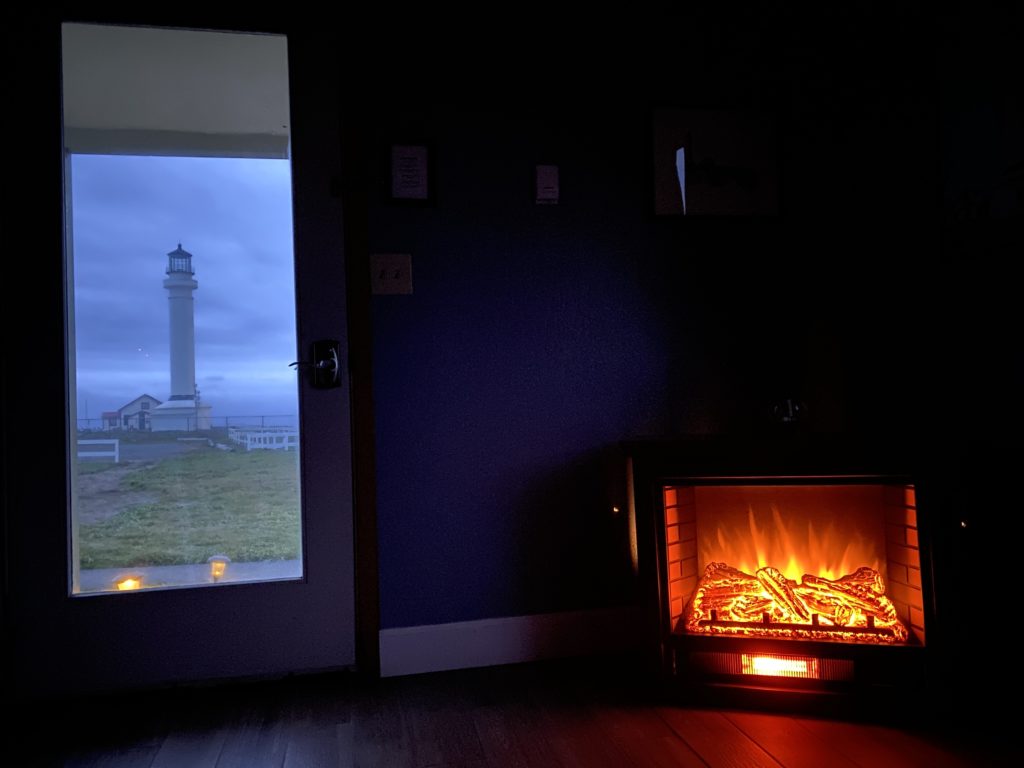
As I drove up the coast to meet you, I managed to stay in the present, immersing myself in the beauty of your neighbors. I hiked rugged coastlines. I napped beneath redwood trees. When I checked into your keeper’s quarters, I was thrilled to learn that I could see your light from my window. I watched you work as the vibrant sunset faded to monochrome.

How many countless people have you guided home safely? As the storm of infection swelled, and the fog of danger thickened, I knew that our time together was short. The future was rushing towards us, and I needed to be home.

It helps though, to know that you’re there.Your steadfast presence on the peninsula, the predictable cadence of your light. A year is a long time to be adrift.


My view from inside the Point Arena keeper’s quarters.